
 |
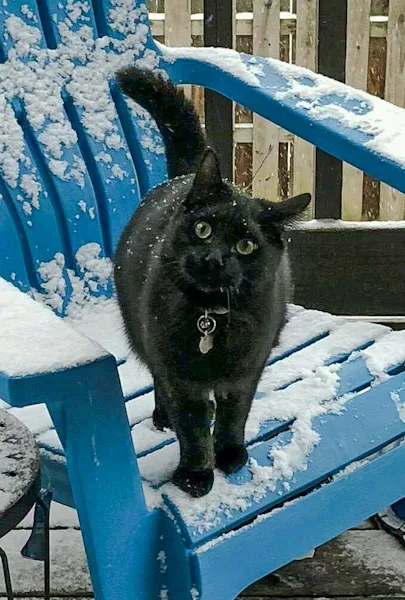
| Black cat in the snow. Picture in the public domain. |
A cat's coat is black because the pigmentation in the fur absorbs a substantial amount of light, whereas in a white cat the opposite is the case, the light is reflected.
Cat coat colors are based on genes that produce the colors, black and red and variations of these. The variations are made by modifier genes, which dilute the colors. Examples would be red turning to cream and black turning to blue or chocolate. In addition, there are genes that produce the patterns (Agouti "A" gene) and genes that create white fur, the white spotting gene.
It is the interplay between these genes that determine coat color.
Black cats are called "solids" in the cat fancy. The solid color breeds (also called "selfs" but I don't know why) have colors, black, blue, chocolate, lilac, cinnamon and fawn. The black color is due to the presence of microscopic granules in the hair (black pigment), which absorb the light. In a black cat these granules are called eumelanin or 'melanin' for short. They are spherical in shape.
Cat coat colors are based on genes that produce the colors, black and red and variations of these. The variations are made by modifier genes, which dilute the colors. Examples would be red turning to cream and black turning to blue or chocolate. In addition, there are genes that produce the patterns (Agouti "A" gene) and genes that create white fur, the white spotting gene.
It is the interplay between these genes that determine coat color.
Black cats are called "solids" in the cat fancy. The solid color breeds (also called "selfs" but I don't know why) have colors, black, blue, chocolate, lilac, cinnamon and fawn. The black color is due to the presence of microscopic granules in the hair (black pigment), which absorb the light. In a black cat these granules are called eumelanin or 'melanin' for short. They are spherical in shape.
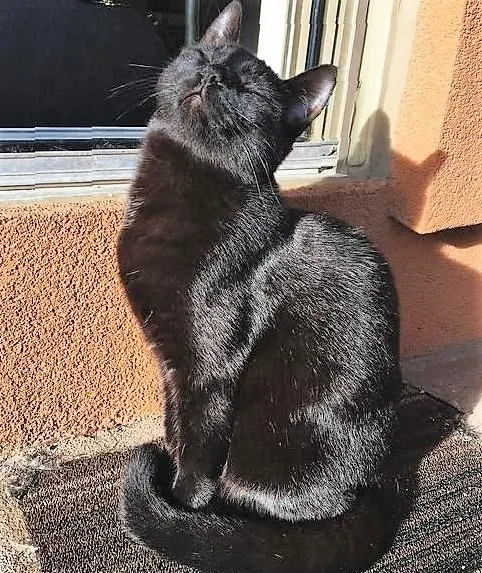 |
| Black cat. Shiny coat. Photo in the public domain. |
The Genes
It is thought that the black cat is a very early mutation from the wild cat tabby coat. Robinson's Genetics says that the black coat is a result of a change (mutation I presume) in one of the genes that dictates the agouti background color. This is because the individual hair strands do not have the banding of yellow pigmentation that is produced by the Agouti gene and are instead mainly black throughout. Any color change of the hair is at the base near the skin where it will be grey (smoke like color).
The browning gene dictates the production of eumelanin in black cats. When the gene is dominant the cat is black. There is also the action of the recessive non-Agouti gene (aa) that suppresses the more natural effect of banding on the hair follicles resulting in solid color. In fact, all self-colored cats have the non-agouti gene shown as aa.
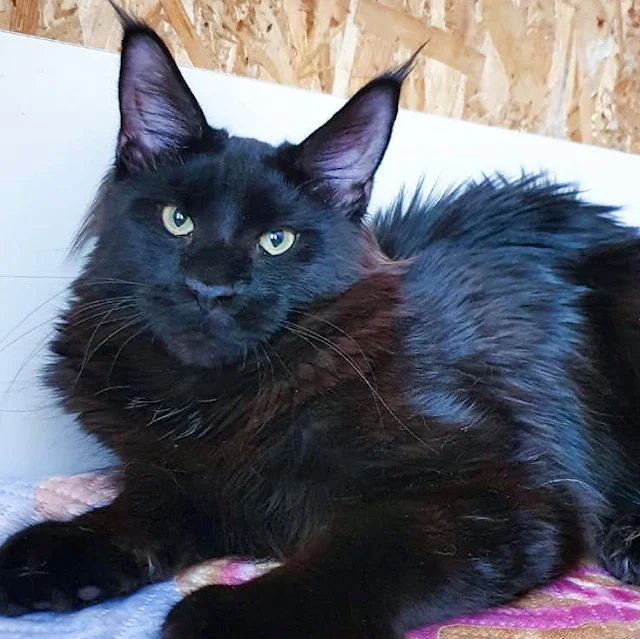 |
| Black Maine Coon with some rust. Photo: Ekaterina Sansaverina Gold. Black is one of the basic self-colours. |
The genes present in black cats are then the non-agouti recessive aa, plus the gene producing black pigmentation B, plus another gene symbolizes by D for dense coloring. A black cat will have these genes present. The non-agouti is always recessive while the alleles of genes B and D can be present as both dominant (BB, DD) or one dominant and one recessive (Bd, Dd).
RELATED: Are black cats friendlier?
Cat breeders will seek a jet black but sometimes a rusty brown tinge is shown. Black Cats showing this phenotype (appearance) would normally be excluded from the breeding program unless there is a pressing reason as to why not. An influence on the density of black coloration is sunlight. Apparently, sunlight and the saliva deposited when grooming combines to oxidize the pigmentation to produce a brown tinge.
You can see a rare black Maine Coon cat by clicking on this lick. If we go up the sc ale of colors to the next level we would probably have the Black Tortoiseshell coat (Tortie) see the picture right. Tortoiseshell is a mixture of the base colors referred to above, black and red. Both these colors are apparent on the coat. The introduction of the red (or more commonly called orange) breaks up the solid black coat.
Finally, it is thought that as the most natural coat color/pattern is the Tabby (as it is the best in terms of camouflage), possibly the first genetic mutation (affecting a cat's coat) was from that natural state to black.
You can see all the posts on coat colors by clicking on this link.
Photograph bottom tortoiseshell copyright and By Gini~
Part of the information for this post has come from Robinsons Genetics
Cat breeders will seek a jet black but sometimes a rusty brown tinge is shown. Black Cats showing this phenotype (appearance) would normally be excluded from the breeding program unless there is a pressing reason as to why not. An influence on the density of black coloration is sunlight. Apparently, sunlight and the saliva deposited when grooming combines to oxidize the pigmentation to produce a brown tinge.
You can see a rare black Maine Coon cat by clicking on this lick. If we go up the sc
 ale of colors to the next level we would probably have the Black Tortoiseshell coat (Tortie) see the picture right. Tortoiseshell is a mixture of the base colors referred to above, black and red. Both these colors are apparent on the coat. The introduction of the red (or more commonly called orange) breaks up the solid black coat.
Finally, it is thought that as the most natural coat color/pattern is the Tabby (as it is the best in terms of camouflage), possibly the first genetic mutation (affecting a cat's coat) was from that natural state to black.
You can see all the posts on coat colors by clicking on this link.
Photograph bottom tortoiseshell copyright and By Gini~
Part of the information for this post has come from Robinsons Genetics





My black cat was gotten from a shelter when she was about 18 months. I don't know her pedigree. She is pure black, not one white hair! Her whiskers, nose, lips and paw pads are black. Even her gums are black. Her undercoat is slightly brownish, giving her a charcoal hue in sunlight. Her eyes are bright golden and the tapetum lucidum blue. I think her total blackness must be rare. But in very bright sunlight you can see faint bands indicating a tabby pattern.
ReplyDeleteI have two black cats and one that is no longer with me. He died at 15 years old. I have other color cats also, but I have found that black cats are the most loving and intelligent of cats. Perhaps I am just biased because my very first cat was black. That is not to say that I do not love my other different colored cats too. I just lost a lynx point siamese and I miss her very dearly.
ReplyDeleteI too have two black cats. I was told they were brother and sister, but as they have grown, (I got them as kittens from a shelter) they are looking more and more different than each other. I'm starting to think they weren't even in the same litter. Fagan is the bold, sneaky one, always trying to get receipts and money from my purse or nightstand, and Fionna is the quiet, stand offish one that mostly watches Fagan get busted in most cases. They both have been inside cats their whole life, they are 3 years old this year. If I left the front door opened, Fagan would be right outside of it, (just going beyond his allowed borders as always) and Fionna would be pacing back and forth to me and the door, telling on him. They both are my children, I love them truly. I had one cat before them, my beloved Hocus, who of course was a solid black cat, too. I had him for 13 years. In honor of him, I got a custom tattoo of his face on the top of my foot. As he always layed to my feet. I do miss him. I have never owned any other type of cat than solid black cats. I believe I have a love of their dominant, yet quiet ways. Their reputation as being a "bad luck" cat offends me as well, as I know they are everything but that. I will always have the love for black cats, I feel they are misunderstood. As a Pagan myself, I know of this from many other situations. My kitties and I have a unique relationship, I would never give that up for anything, including silly superstitions. Blessings...Juno
ReplyDeleteI love my black cat, I have no idea of her breed. She is all black except her back paws and her chin. She loves to lay on my lap but hates to be held!!! Any suggestions email me at hannahroan@sbcglobal.net
ReplyDeletemy cat is jet black with the most amazing green eyes
ReplyDeleteMy cat is also jet black, but he has the most amazing green-yellow eyes. I named him Jet 1) for his speed and 2) for his jet black fur. I don't know what breed he is and have always wondered. But I now think he is a Black Maine Coon Cat. But unsure. I love him dearly and think he is very smart. He has been an indoor cat for the 2 or 3 years of his life, but has always been interested in the outdoors. He escapes whenever he can. I love him as big as space even if space never ends. And nothing can ever change that.
ReplyDeleteWe've had several black cats, dearly loved all. Our 3yo and our freshly-neutered kitten were outside hunting and sadly got caught by some coyotes and killed about 6 mos ago. This left us with 2 cats, Jinx-a 17lb grey tabby, and Mama-a dear black cat with soft, silky fur. I don't want to be a downer here, but Mama had been ill for some time; I just thought it was allergies as that was all I could find online that matched her symptoms. She was eating, drinking, racing around, and her "third eyelid" wasn't showing. We planned on taking her to the vet. When my husband noticed she had lost a lot of weight we knew we couldn't wait. We took her, the vet did blood work and cytology on her lymph nodes which were oddly swollen. She had a fever. He gave her an antibiotic shot, sent us home with drops, and we were to call the following Thursday for results. Well, on Wednesday afternoon I picked my son up from school. The day before I had sensed Mama was getting worse, and I held her and wept as my husband encircled us both. My son and I had a lively conversation (he's 16 & usually just goes to his room & gets online) laughing and talking and looking at funny stuff on the web. He went to his room after about 30 minutes, and I started picking up a bit. I looked over and saw Mama lying on the floor. I KNEW she was gone. But something in me refused to believe it; I put my ear to her, I blew in her eye, I even went so far as to get a mirror to check for even a shallow breath. All to no avail, she was not there. I called my son in and sobbed on his shoulder. She was special, she was the runt of a litter we learned, had congenital hip-dysplasia and was born with a crooked-to-a-right-angle tail. We had rescued her from a neighbor whose brother used to come over and whip her with his wallet chain. It literally took us years to get her to not startle at even the slightest move. Even more time was needed before she felt comfortable being in the same room as us. In the last 2 yrs she was really coming out of her shell. I will miss her very much.
ReplyDeleteShe was a Queen, and I want to commemorate her on this Black Cat page. =^..^=
You people are insane
ReplyDeleteWhy?
Deletecan we ever talk about animals without the atheist evolution crap being shoved down everyone's throats?
ReplyDeleteSherrod, who is talking about "atheist evolution crap"? I fail to see it on this page but I may have missed it.
Delete