
 |
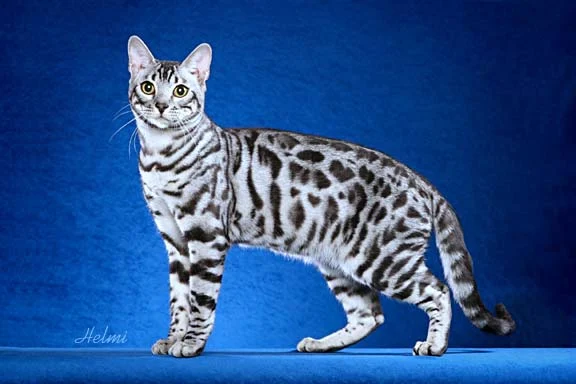
| Bengal cat - photo copyright Helmi Flick |
Bengal cat behaviour is particularly interesting to cat lovers and of course to people thinking of adopting a Bengal Cat. My cats are non-purebred cats, very domesticated, domestic cats. I am therefore very familiar with their behaviour. I have researched the activities and behaviour of the Bengal Cat.
Please note that there are several posts about Bengal cat behavior on this website - use the label links to see them. For example this says some more on the breed. There are some good posts on health as well (HCM - a heart disease for example and PRA).
We know that some people like to keep F1-F3 fillial Bengal cats. These are more like the Asian Leopard Cat than the F4s and SBT (Stud Book Tradition - meaning in a basic sense domesticated Bengal cats) cats.
But the ordinary fourth generation (and more) Bengal cats still have a good amount of wild genes in them (12% for F4s). And frankly this shows a little at least sometimes. The Bengal cat is intelligent and active and therefore needs more stimulation than perhaps some other well know cat breeds. I also believe that they need more space to roam in.
I am one of those that believe they cannot be truly content locked up indoors all the time as it is too removed from the wild. I hear stories of them "escaping" from the house routinely. And of what breeders call, "inappropriate elimination", peeing in the wrong place. This can be because of emotional distress.
Animals in the wild will have various signals that they make to say they are here and stay away. Obviously one such marker for a cat is the smell of his urine sprayed on his territory. Markers such as these help avoid fights and improve survival. The age of the smell (i.e. faded or not) will tell how long ago the cat was there. It may be fair to say that Bengal cats spray more than usual, but this is anecdotal.
 |
| Five F1 Bengal cats. Photo copyright Helmi Flick. |
Domestic cats have adapted to living close together in a household when there is more than one cat present. Normally a wild cat is solitary. This is a measure of the cat's ability to adapt.
One extremely interesting behavioral trait that you might see is what I believe to be a signal from the Bengal cat to other cats to respect her space. A Bengal cat may make a strange puffing sound (an extremely unfamiliar sound for a cat to make) when she wants to tell another cat keep their distance and perhaps to apply a little bit of dominance on the other cat.
This is a similar action to cats swiveling to the front their half flattened ears. This applies for example to the Serval, the wild parent of the Savannah domestic cat. They do this (in part) because there is a white blob on the back of the ear which sends a signal to stay away, beware.
The puffing sound is something new to me. The Bengal has a number of (lets say wild/active) characteristics that are manifest in her day to day activities. Another is the liking of water, a throwback to the Asian Leopard days of fishing and catching food by the water's edge in her natural habitat. Bengal cats can be great paper and cardboard chewers as well. This I see as a hunting, eating and killing play.
These wild traits are more apparent in the Bengal, an active and some times demanding cat. My reading certainly indicates that they are much more demanding than my female black tuxedo cat who is at the foot of my bed as I type this. They sometimes exhibit what breeders call weird behavior. They can bite in play more aggressively perhaps than the average domestic cat.
See and read more on Bengal Cats behavior by clicking on this link and on this link for general information. Or use the labels link in the side bar and see all the posts about the Bengal cat and select from there.
From Bengal Cat Behavior to Bengal Cats





My half-Bengal (half British Shorthair) is the most gentle kitten I have ever had. Usually kittens scratch and bite me to bits but this little guy only puts his mouth around me with a little pressure and hardly ever has his claws out! He also likes rid9ing on my shoulder!
ReplyDeleteyour post is very true. i have two bengals that are both almost two years old. the female tends to show more wild traits then the male. she's also a little reclusive. they "hunt" my dog by stalking. it's wierd.they love to shred everything, especially cardboard. i have had cats my whole life, these cats shocked me at wild they are eventhough they are domesticated. they have a bark sometimes, it freaked me out the first time i heard it. they are very cool pets because they are so different.
ReplyDeleteI have two cats ~ (moggies) and we are having problem with our next door neighbour cat. A Bengal Tom who is very aggressive and have attacked them on various times. I have spoken to the owner who is a Vet but disagrees her cat is a problem and is very friendly. Can we do anything else unless a serious issue occures and then do the police get involved. I just feel our cats and the rest of neighbours cats are not having a good life with this bengal cat being around. Thanks for any advice. Tania
ReplyDeleteTania, if your cats are being attacked by the Bengal- I presume the Bengal is allowed to roam outdoors freely.
ReplyDeleteMost breeders make adopting parents sign paperwork that states the Bengal will NOT roam outdoors freely because of their instinct to hunt and territorial behavior. Please remind your neighbor of this and if you know the breeder they got their cat from, contact them. Such behavior will be at the risk of the adopting owners losing their Bengal. I have a Bengal, so I am speaking from experience. I can 'walk' him on a leash but can not allow him to roam freely.
Thank you Me. You have been a great help. That good information and I didn;t know you had to have paperwork for the cat. We know it needs a new home a nice farm would be great Kind Regards Tania
ReplyDeleteI have two male brother Bengal purebreds (Leo & Biggy) who chirp and click at each other and when they fight, they make that puffing noise. They are both neutered and I think I might enter them in a show. This page gave me a few cool facts. Thankyou.
ReplyDeletei think i have a part bengal cat, because his back has the markings. his legs and part of his face are white though. i dont know if he likes water, and he's scared to go outside because of the chickens, turkeys, and geese. but one time i threw a straw he'd been playing with, and he brought it back for me to throw again. this is now one of his favorite games. also, i have a golden retreiver who's much bigger than my cat is, but my dog for the most part leaves my cat aone. Whenever the dog walks by, the cat hides then pounces on his back leg. isn't that wierd? do you think my cat is part bengal?
ReplyDeleteTania
ReplyDeleteI have a Bengal male (neutered) who is allowed to roam freely outside and has never been kept in. He is soft with other cats, to the point that he has been bring home a local stray, plus we have two cats that live next doors to us and if anything they attack him ..so its not about the fact that you neighbors cat is a Bengal its just cats in general.
Tania I was delighted to find someone else with the same problem. We have a Bengal next door who is nice as pie to humans but evil with other cats. He enters our house at night to attack them and I have spent a fortune in vets bills. Our other neighbours have the same problem and the owners are in denial saying how gentle their cat is and that they are only doing what other cats do. That is just not true as other cats have cat ettiquette and rarely enter other cats homes. One of my cats wet herself in fear the other night and the screams are only the sort that are made when a cat thinks they are going to die. Their 2nd Bengal went misteriously missing overnight and yet that does not seem to ring alarm bells with the owner. Even a magnatised door does not stop the cat as it is so large that the obstacle is nothing to them.I was very pleased with the reply as I now have somthing concrete to work on. Lynette
ReplyDeleteI have a bangel hes very sweet. Hes nutured but ive had no problems...
ReplyDelete