
 |
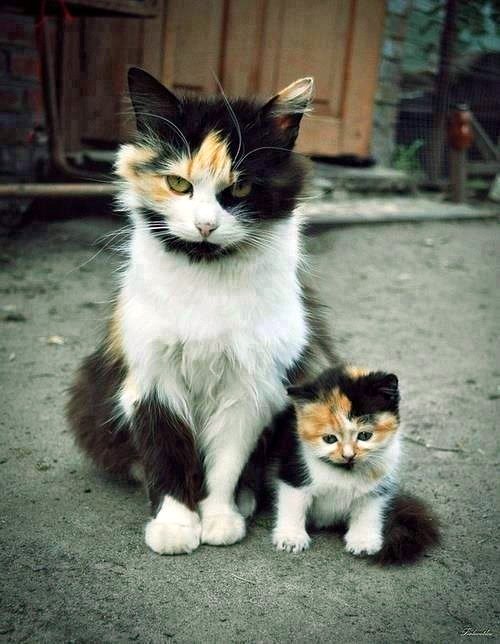
| Calico cat and her offspring. Photo in public domain. |
Japanese people like the calico color. This is shown in their love of bicolor and calico Japanese Bobtail cats. They call this color pattern mike-cats or 'tricolour' cats.
The genetics at work are all concerned with the coat color. As far as I can see there is no further effect (beyond coat color) that determines the character of the cat. I conclude that calico cats have no specific character associated with the coat color.
However, I may be wrong because Dr Bradshaw says that there may be a link between coat type/colour and personality in pedigree cats due to selective breeding. Breeders may create this link by choosing foundation cats which have a nice character plus the desired coat. It is an artificial connection in purebred cats due to human intervention.
RELATED: Ginger Cat Personality.
The association between the color of the fur and character of the cat is similar to our perception that red-headed people (and particularly females) have a specific and associated character e.g., fiery and volatile. This is due to their "difference" (in the way they look). People tend to be frightened of different people and attack them.
In the same vein the calico and tortoiseshell cats are considered to have 'catitude'. We tend to stereo cats according to their coat type and colour. Sounds familiar?
They do this by making slightly derogatory remarks (this is my theory, anyway). It is untrue that red-headed people are generally fiery. If they are sometimes like that, perhaps they are being irritated by being thought of as being fiery by other people! I can't find evidence on the internet which scientifically links red hair with a specific personality traits. Wrong? Please tell me in a comment.
One point though does come to mind about the behavior of a calico cat. We know that females of the species act differently to the male. As calico cats are nearly always female it could be argued that their behavior is different to the average. Just a thought.
There is a tendency then for humans to assign a character to an appearance. This is the same for people's perception of cats generally. Some people hate cats because they think they "sneer" at them when it is in fact the person's own prejudice coloring the perception. The same distorted perception is found with black cats. They were thought of as witch's cats and there are still numerous superstitions surrounding black cats (good luck, bad luck you name it).

Sources:
- Me
- Wikipedia
- Cat Fanciers





Genetics are nearly correct. Orange and black are both carried on the X chromosome, so for BOTH to happen, the cat has to be XX. A male cat can be only orange or only black, but not both.
ReplyDeleteCorrect. ONLY females are calico because it is a genetic happenstance. And the white is what differentiates them in North America; i.e. they are either calico or tortoiseshell, never both. If it has white is a calico, if it does not then it is a torti.
ReplyDeleteI call them Calicos and I am from the UK. I don't think I could be bothered with the length of the title for Tortoishell & White! Calico sounds so much nicer. However, I did think that torties and calicos COULD be male, but that there is a very small percentage and they are usually sterile
DeleteXXY males and XX males can also be calico as can tetragametic chimera males who have two different sets of XY genes.
ReplyDeleteRecent studies show redheads experience more pain than the rest of us (see http://well.blogs.nytimes.com/2009/08/06/the-pain-of-being-a-redhead/), so perhaps it isn't all stereotype.
ReplyDeleteVery interesting. If they feel more pain, no wonder they are hot-headed!
DeleteI like to know about their intelligence on average. I have a calico who is not only playful and affectionate, she is quick to pick on things like only clawing on her cat tree and not the furniture.
ReplyDeleteI have only had one calico, I have had tabbys, black and white cats and black cats. I do have to say that the calico I have is the most intelligent cat I personally have owned. I really like tabbys and the ones I have had before have always been really soft. My calico is feisty, but very affectionate. She goes to the toilet outside and my other cats wouldn't. So just out of my experience, my calico is the most intelligent! It may just be a coincidence, but she is the most intelligent cat I have had and also compared to others my friends have had.
Delete