Showing posts with label cats with dogs. Show all posts

Monday, 16 August 2021

4 Covid reasons why pet owners in Indonesia have abandoned their pets

There are 4 Covid reasons why Indonesians have abandoned their companion animals at this time. Are they valid? Could they have been avoided in some instances? They are as follows:

  1. Because of the pandemic many people have tested positive and a large number of those have gone to hospital. They had to leave behind a companion animal to be cared for by somebody else. In some instances, the cats and dogs were, in effect, abandoned until rescued and taken to a rescue centre;
  2. When Covid sufferers have recovered, if they have recovered, sometimes they don't return to reclaim and be reunited with their companion animals. They give them up;
  3. Sometimes Indonesians are frightened about the news of transmission from cats and dogs to people and therefore they abandon their companion animals in order to protect themselves from getting the disease. Note: the talk of transmission from companion animals to people, I believe, is exaggerated. It is possible because this is a zoonotic disease but people should not be overly-fearful of getting the disease from their pets. It is more likely that pet owners give the disease to their pet.
  4. Sometimes companion owners end up in hospital with the disease and sadly they don't recover; they pass away and therefore leave their companion animal uncared for. I suppose they end up in a shelter where they are hopefully rehomed provided the animals are spotted and rescued.

The story about Indonesian animal lovers being separated from their companion animals due to Covid is disheartening. There must be many cases of abandoned pets. One example was a four-year-old Indonesian pit-bull dog who was at home alone for two days without food when a group of volunteers found her. She was left behind when her owner tested positive for Covid-19. Query: why don't these cat and dog owners make arrangements for their pet to be cared for? They must have time to do this, surely?

Animal Defenders shelter, Parung, Bogor
 Animal Defenders shelter, Parung, Bogor, West Java, Indonesia.

The reports coming back from Indonesia are that the country is battling one of the worst coronavirus epidemics in Asia. There have been over 100,000 deaths. The Animal Defender animal rescue group have started the AD-19 program to rescue companion animals left in limbo when their owners have to deal with the coronavirus infection.

There must be an enormous amount of pressure on animal rescue centres under these circumstances. Costs are substantial. The founder one shelter said that the costs are about $8000 per month to run.

I sense though that people who get Covid-19 are sometimes being careless with respect to their pets.

Tuesday, 29 September 2020

Is this lion greeting the dog or asking for forgiveness?

A funny bloke on YouTube said that the lion was "taste testing!". It made me laugh. The video maker said that this white lion is asking his dog companion for forgiveness. He picks up the dog's right leg and it is almost as if he kisses the paw. It is a very gentle and friendly act. You will find nothing on this type of lion behaviour in the best books on the wild cat species so we have to work it out for ourselves.
 

In my opinion the lion is not asking for forgiveness. He is simply greeting the dog in a friendly manner. It's almost like handshaking and it practically mimics the handshake of humans (but not during the corona virus pandemic!). There may be an element of reinforcing friendship in the greeting which is what friendly greetings are all about anyway. 

Immediately after the "handshake" the dog turns and leads the way. The lion follows. Perhaps the dog is the leader in this super duo? This is my interpretation. There is one thing certain: they are very close emotionally. They have formed an incredibly strong bond which clearly indicates that they were raised together and have lived side by side since they were toddlers to use language designed for people.

Emotions and self-awareness

The act of asking for forgiveness requires that the non-human animal or human animal (human) asking knows that they're done something wrong. The way that they know they have done something wrong is by measuring their behaviour against some standard or norm. Those standards and norms come from society in the human world. Can dogs and lions have their own standards and norms that relate to a friendship like this? I would doubt it. 

Also the act of forgiveness probably also requires the ability to be self-aware. You have to be able to look at yourself from outside yourself, objectively. It's as if you are measuring your behaviour against some standard and this requires self-awareness. There are doubts, considerable doubts, as to whether cats can be self-aware. There are also doubts about the higher emotions in domestic and wild cats. Forgiveness is born out of a feeling of guilt and perhaps shame. These are higher emotions. I would doubt that the lion feels these emotions. This is not to in any way denigrate this beautiful relationship and the tender behaviour of this fantastic looking lion. I'm just trying to look at it realistically.

Friendship

It is well known that cats make friends with other cats and have interspecies friendships with, for example, dogs. Cats have friendly greetings like the tail-up position and the nose touch. Friendship is based upon affection and affection is an emotion which most people agree cats can experience. Of course dogs make friends with other dogs and their owners as well. These thoughts support my assessment that what we see in the video is a very friendly greeting which may have been trained into the lion and the dog by their owner. We don't know.

Saturday, 10 December 2011

What cats are good with dogs?

Cats that are well socialized to dogs during the first 7 weeks of their lives are usually going to be good with dogs. In addition to that there may be some cat breeds that are better predisposed to being good with dogs. However, the most important factor will be socialization.

People like to speculate what breeds are best with dogs. In general it seems that these breeds are known to be even tempered types such as the Ragdoll, Persian, Manx, Cymric and American Shorthair. The American Shorthair is also said to be good with children.

The breeds that are less likely to be good with dogs are the more excitable cat breeds such as the cats associated with the Siamese such as the Oriental Shorthair, Javanese, Balinese and Burmese. The Abyssinian is also not suitable. But these are really a little speculative. People like lists and certainties but you won't get them.

In addition to certain cat breeds and good socialization, a third factor is the individual cat's personality. Within those breeds that are supposed to be unsuitable will be an ideal cat that loves dogs. We should also recognise the moggie. Many random bred cats will be good with dogs.

The best thing is to test individual cat to individual dog if that is possible.

Associated page: dog breeds that get along with cats.

Tuesday, 7 June 2011

Dogs Eating Cat Food

You're concerned about dogs eating cat food and want to know if it is OK. I guess in mult-pet households where there are dogs and cats, dogs might well eat cat food and vice-versa. Incidentally, it is more of a problem if for cat if she eats dog food than for a dog is he eats cat food.

dog eating cat food
Plush toy dog eating Venezuelan food
Photo by JunCTionS (Flickr)

In some ways the concern about dogs eating cat food is a bit odd. On a common sense basis we know that the food prepared by pet food manufacturers is different for dogs and cats. That in itself tells us that dogs have different dietary requirements to cats.

So, allowing a dog to eat cat food will at the very least be less than ideal and may, in the long term, have health consequences. We can deduce that without any knowledge of cat or dog food, or cat and dog health or biology.

If it is relatively easy to ensure that our dog eats dog food and not the cat's food then common sense dictates that we should make the arrangements.

I sense that the problem is that in households where there are cats and dogs some people understandably find it hard to make sure the cats eat cat food and the dogs eat dog food! The concern is more about how to get dogs to eat their food only in the multi-pet household. One internet commentator says that he keeps dogs from eating cat food (which is attractive to a dog because it is rich in protein and perhaps smells nice) by placing the cat food high up and the dog food on the floor. Cats are excellent jumpers, better than dogs so they can get to their food but the dog can't. As cats are less interested in dog food than dogs are in cat food, leaving it on the floor does not lead to cats eating it. Another friend, Elisa, says "cat feeders are on the bar out of reach. Back in the 80's my 2 dogs ate all cat food and both lived healthy lives...." Read on though..

Adding a bit of detail to the differences between cat and dog nutritional requirements, the authors of Cat Owner's Home Veterinary Handbook say that "cats require...about two to three times as much [protein] as dogs. On that basis we have to ask, "what are the health consequences of a dog eating a diet that is far too high in protein?" Note: cat food is also too high in fat for a dog (src: ASPCA).

Both cats and dogs are carnivores but Linda P Case in The Cat Its Behavior, Nutrition & Health, says that cats have "more stringent dietary requirements than those of more omnivorous species, such as the dog." Dogs are more flexible in their dietary requirements than the obligate carnivore, the cat.

How does this difference manifest itself if a dog eats cat food? Clearly if a dog eats some cat food, sometimes, there cannot be a problem particularly if the added protein in cat food is offset by providing low protein dog food as well.

But for a dog that only eats cat food - what happens then? Well, I have heard from one commentator that it can cause diarrhea. I have no authorities to support that, however. The School of Veterinary Medicine at University of Missouri says that in the long term it can cause serious health problems - organ damage. Clearly it is dependent on the individual dog. ASPCA says that dogs eating cat food can lead to them developing gastrointestinal problems that includes vomiting and diarrhea. Personally, I think that the likelihood is that in general the dog would be OK but in individual cases he or she won't.

I'd stick to the rules and find a way to stop the dog eating the cat's food! If you are interested you can read about the opposite: Cat Eating Dog Food. This helps us understand the effect on dogs eating cat food, as well.

Michael Avatar

From Dogs Eating Cat Food to Home Page

Tuesday, 24 March 2009

Cats are Less Flexible than Dogs

In a household of cats and dogs or where a person wants to introduce one to the other, it should be noted that research indicates that psychologically cats are less flexible than dogs. This translates to greater success in the introduction of a cat to a dog and visa versa if the cat is in the household first.
Picture in public domain.

Cats are more territorial while dogs are more concerned about the person and where the person is than specific territory. The territorial instincts of a cat results in more stress when space is invaded with the consequential barrier to learning. I can vouch for this personally. Not in relation to cat and dog but cat to cat. My cat is very defensive and quiet. She gives way to bigger strays that come in (Timmy a large boy cat) but attacks a smaller cat than invades her territory (Pippa - a small female) - see Three Stray Cats

She is distinctly typically territorial and can suffer from stress. The invasion of her space by time share cats coming in the cat flap concerns me and I am working on it. That said, when cats are in place in their territory (our home) and young enough (aged 6 months or less) and a dog of less than one year of age is introduced to the cat they can learn to get on fine. In fact they can learn the body language of the other animal even though it is not like theirs. 

For example, when a cat wags her tail it can be a sign of agitation but for a dog it can indicate a friendly attitude. This difference appears to have been noted in the cats and dogs that were part of the research project that was carried out by authors Neta-Li Feuerstein and Joseph Terkel. Also, in well socialized cats and dogs, when they great each other they use the Eskimo kiss, smelling the other at the nose rather than the rear end. My cat does this to me as we are beautifully socialized! 

Conclusion

In a household where the people would like to integrate cat and dog companion animals it would seem that a degree of advanced planning is the preferred route to take into account the fact that cats are less flexible than dogs and that their period of most productive learning is shorter at 6 months rather than one year for dogs. 

Thursday, 21 August 2008

Dogs and Cats

cat and dog together
Dogs and cats together - Photograph copyright myriorama under a creative commons license.

Some know it and some don't but dogs and cats can get along fine provided there has been the proper amount and quality of socialization. This has been confirmed and reinforced by research carried out recently by scientists doing research work at Tel Aviv University in Israel.

The number one finding is that dogs and cats can be friends (and some of the pictures show this clearly) provided they are introduced at a young age and the dog is introduced to the cat who is the first to occupy the territory. The cat has to be in place first because dogs get jealous when another animal be they human animal or animal are brought into the family after the dog as the newcomers will inevitably take away some of the attention that the dog was getting.


Dogs and cats together - photo copyright Scott Kinmartin - published under a creative commons license.

Dogs and cats socialized together at a young are learn to communicate with each other through body language. This is particularly good as dogs use different body language to cats so some learning is required. It doesn't come naturally. For example when a cat wags her tail it can mean agitation or aggression while for a dog it is the expression of a friendly emotion. Obviously a form of communication such as body language is extremely useful to the relationship. A lot of humans might learn something from this in fact. This clearly helps them to get along.


photo by fazen under a creative commons license.

An example of a dog learning a cat's body language is sniffing the cat's nose normally a cat to cat greeting (see picture above), when dogs sniff the other end of another dog when meeting each other.

There are endless examples of well balanced and successful relationships between cats and dogs. Now we know how it happened. Although I expect dogs and cats can make friends late in life too under the right circumstances and provided the cat and the dog have generally well socialized characters.

See some of the best dogs and cats together pictures

Thanks to the research authors: Neta-Li Feuerstein and Professor Joseph Terkel

Monday, 26 May 2008

Dog Allergic to Cat

pollen
Pollen - once source of a dogs allergic reaction photo copyright massdistraction

A dog allergic to a cat? Yes, just as humans can be allergic to cats, dogs can be allergic to cats too. I am slightly allergic to a stray boy cat that pops in for food. It is the first time that I have sensed this. It is quite uncomfortable. I've only got to look at him, almost, and I start to feel itchy. I always wash after touching him.

Dogs allergic to cats cannot rationalize the problem like humans and as far as I can see there is not much one can do about it that is really effective. First though, if your dog is scratching it may be due to a wide range of sources. A dog may even be allergic to us as we produce allergens in the form of skin particles. Cat allergens are skin particles and/or dried saliva left on the after grooming.

It may be difficult to track down the source of irritation. There is the question as to whether you tackle the problem from the dog end or the source end (i.e. pro-action or reaction). I would have thought that prevention is better than cure so tracking down the source is important.

Potential sources other than your cat could be for example, the food he eats. It may be due to the type of protein in the food. You could try different types of dog food. Apparently the type of grain in the food can (rarely) be a source of allergic reaction. Food allergy generally, seems to be relatively rare, however. Mold spores is another possible source. I guess you'd know if you have a mold problem as it is very visible. If your dog is itching and you have mold somewhere in or around the home the two could be associated.

Cat allergens have a long life and can be present in the home for long periods attached to furniture etc. My research indicates that the best way to deal with cat allergens is to wash them off the cat, but most cats will find this unpleasant (some cats like water however - Bengal being one example). If this is done regularly (once monthly) it may assist. I'd certainly try and see. It could be a good way of testing the source. Wash you cat and see if your dog does less scratching.

There are products on the market that seal the cat dander to the body, preventing contact with it. I don't know how effective these are but I would have thought not very effective. There is quite a big market in hypoallergenics including breeding hypoallergenic cats (Allerca pets). One product is Danderseal®. It doesn't seem to be widely available and is limited it seems to the North American market (USA and Canada).

Another product is Allersearch X-Mite®, which neutralizes allergens in or on the carpet. You sprinkle it on and hoover it up - no idea how effective it might be. This also seems to be exclusively a US product.

As cat allergens are airborne a free standing air filtration unit may help. BlueAir are good quality but more expensive than some. There are lots on the market. If you can hire them (probably) it may be wise to hire for a week and "suck and see". If your dog improves you would have found at least one potential source. I'd have thought the testing process could be carried out for each potential source to gauge the reaction.

The cause could be pollen (a seasonal allergy). If your dog scratches seasonally then I guess it could be pollen. Your vet can carry out a test if this source is indicated. If it is not pollen it could be due to the vastly increased number of insects flying/walking around during the warmer seasons. An insect bite can cause an allergic reaction from the insects saliva deposited in the skin.

If you can't track down the source you'll have to treat the symptoms with drugs such as antihistamines such as Benadryl®. Once again I am nor sure how effective they are for pets and I'd be extremely careful (get vet advice). Another symptom reducer would be steroids (possible long term side effects - I'd personally avoid these).

The best route is obviously prevention, which will take more time to resolve and requires running tests. Dog allergic to cat might be dog allergic to something else.

Source: www.allergicpet.com

Dog Allergic to Cat to Home page

Wednesday, 21 May 2008

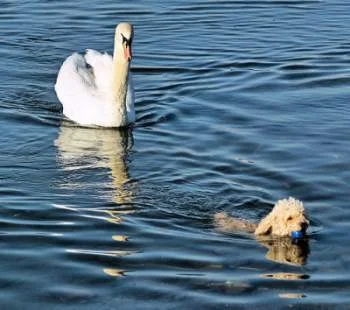
Dog chasing cat

swan chasing dog
photo copyright jgrantmac

People looking for a dog chasing cat picture will in fact see the above, a swan, hissing like a cat, chasing a dog. Confused? Actually this is a serious post but I like the picture.

Sometimes cat breeders let other cat breeders keep their stud cats (I guess for a fee). Sometimes breeders have other animals like dogs. This means the breeder is who is going to "loan" the cat to the new breeder with dogs has to decide if it it safe to do so.

Stud cats are sometimes (often?) kept in outside cages for practical reasons. Or indoors permanently. Will the new breeder be as diligent as the other in looking after the cat? Will the cat get out and be attacked by dogs? These are considerations for a breeder who will be saying goodbye for a time to a much loved cat. Although cat breeding is a commercial enterprise breeders form close relationships with their cats.

I read a sad story of a cat breeder's huskies killing a Bengal cat that had been loaned for breeding purposes. The cat was able to get out and the dogs chased and killed the cat - extremely distressing for both the breeders. This was more than a dog chasing cat scenario.

Whether a dog chases a cat depends largely on the upbringing of the dog; whether they are well socialized with cats and other pets and humans. Clearly good early socialization will be necessary if you are considering mixing cats with dogs. Some dogs are great with cats.

However, it would seem that some dog breeds are more likely to attack a cat than others because of the long term breeding program associated with the breed of dog.

For example the Siberian Husky has been described as a "keen and efficient hunter and killer". This dog breed apparently cannot be trusted with other animals (non canine animals) including cats unless the dog has been brought up with a particular cat and even then they have, it seems, been known to attack the cat for no reason. Conclusion (if this is correct): don't mix cats with Siberian Huskies or perhaps any type of Husky as you're likely to get a dog chasing cat situation with a very sad end.

On the other hand some dogs are considered safe around cats (provided they are properly socialized) and these are for example Great Danes, Cavalier King Charles, Shih Tzu. I am sure there are many others.

The Great Dane is not considered dangerous despite her/his size and is friendly towards other animals including cats (as a breed trait). The Cavalier King Charles can even act like a cat sometimes, cleaning paws in the same way for example and finding high places to perch on.

The Shih Tzu requires socialization to become totally trusting with other animals but is not dangerous it seems. Conclusion:- a cat breeder or anyone else for that matter should think long and hard before letting another person who keeps dogs, look after her cats. And remember in the USA lots of cats are declawed so she can't defend herself. Plus they are often kept indoors permanently which means they may try and escape at the new home. The dog chasing cat scene can be amusing for some but deadly for others.

Source: Siberian Husky Breed Club, Me

From Dog chasing cat to Dogs with cats

Featured Post

i hate cats

i hate cats, no i hate f**k**g cats is what some people say when they dislike cats. But they nearly always don't explain why. It appe...

Popular posts