Showing posts with label History. Show all posts

Monday, 8 April 2024

Ship's rats preserved in tar since 1373. Analysis of Black Death bacterium.

Scientists hope to be able to found out which variant of the Black Death bacterium caused one of the deadliest pandemics in human history. They have discovered two rats preserved in tar in a shipwreck recently uncovered in Estonia.

The date of 1373 is ideal because that is in the middle of the era of the Black Death in Europe. The scientists want to find out the variant of the bacterium which killed so many people. You may remember that at the time people thought that cats spread the disease but it was humans (see below) so by killing the cats they made things worse. However, it is a myth that there was a mass culling of cats.

The discovery of this ship containing two preserved rats is revealed in the second episode of the Channel 4 series Bettany Hughes' Treasures of the World. It will be aired on April 13.

Ship's rats preserved in tar since 1373. Analysis of Black Death bacterium.
Image created by the masterful DALL-E. 

Bettany Hughes said that she heard about the unbelievable discovery of the ship and she told The Times (the source of the story for me): "It's the biggest archaeological maritime find on land ever. Then, a few months before we were due to be filming in Estonia, we heard about this incredible discovery of the rats. A barrel of tar had fallen over and mummified them. So they have been preserved in tar. You don't get organic material like that preserved from the fourteenth century. It's almost unheard of."

She added that, "It's the first time we've got a potential candidate for the Black Death carrier. It's bang on the absolute peak of the Black Death surge in Europe, so it would be extraordinary if the rat turns out not to have it."

They've already analysed their hair and stomach contents. The stomach contents would also tell us about the diet of the sailors on the ship at the time.

They hope that the rats test positive for the bubonic plague and if so they will be able to discover the variant that caused the pandemic.

It's believed that the ship was part of a powerful trading network called Hanseatic League. It was discovered in 2022 during construction work in Tallinn, the capital of Estonia.

The area was once underwater. The ship had sunk close to the mouth of the River Harjapea.

The ship has overlapping planking, sealed with animal hair and tar. "We have found wool material used for packing, we have also found some tools and fragments of mediaeval leather shoes." - Bettany

The Bacterium


The Black Death, a devastating pandemic that swept through Europe during the 14th century, claimed an estimated 25 million lives between 1347 and 1351. Historically, rats have been blamed for spreading this deadly disease. However, recent research challenges this assumption.

Yersinia pestis, a bacterium, is the culprit behind the Black Death. In 1894, bacteriologists Kitasato Shibasaburo from Japan and Alexandre Yersin from France independently identified this pathogen. They discovered that it was carried by fleas, which acted as parasites on both rats and other small rodents 1. These infected fleas, in turn, sought out and bit humans, transmitting the disease.

Contrary to popular belief, rats weren’t the primary carriers of the plague. Instead, it was humans who facilitated its spread. Simulations conducted by researchers revealed that the model focusing on fleas and ticks on humans best explained the disease’s transmission in European cities. The plague moved too swiftly for rats to be the sole culprits. If rats were the main cause, we would expect more archaeological evidence of dead rats, but historical and archaeological records provide little support for this claim 2.

So, while rats play a role in the Black Death narrative, it was ultimately human interactions that allowed the bacterium to wreak havoc across the continent. The fleas, hitchhiking on humans, acted as the bridge between rodents and people, leading to one of the most devastating pandemics in history.

Today a simple course of antibiotics cures the Black Death. This critically important drug was unavailable at the time.

-----------

P.S. please forgive the occasional typo. These articles are written at breakneck speed using Dragon Dictate. I have to prepare them in around 20 mins.

Saturday, 16 March 2024

How did Henry Bergh, the founder of the first SPCA in North America, spend his life?

This week, 136 years ago, the animals lost a great friend. On March 12, 1888, Henry Bergh, the founder of the first SPCA in North America, died. For two decades, Bergh had taken to the streets to protect animals. 

How did Henry Bergh, the founder of the first SPCA in North America spend his life?
Henry Bergh. Image believed to be in the public domain.

This is how he described his life as an animal advocate of his time. 

“Day after day, I am in slaughterhouses; or lying in wait at midnight with a squad of police near some dog pit; through the filthy markets and about the rotten docks; out into the crowded and dangerous streets; lifting a fallen horse to his feet, and perhaps sending the driver before a magistrate; penetrating dark and unwholesome buildings where I inspect collars and saddles for raw flesh; then lecturing in public schools to children, and again to adult Societies. Thus my whole life is spent.”

The above comes from Nathan Winograd's newsletter.

Below is from Bing's co-pilot. 

Henry Bergh, born on August 29, 1813, in New York City, led a remarkable life dedicated to animal welfare and the protection of children. Here are the key aspects of his impactful journey:

  1. Founding the ASPCA:

    • In April 1866, just three days after the first effective legislation against animal cruelty was passed in the United States by the New York State Legislature, Henry Bergh founded the American Society for the Prevention of Cruelty to Animals (ASPCA).
    • His mission was clear: to ensure that animals received kind and respectful treatment from humans and were protected under the law 2.
    • Bergh assumed the role of ASPCA president and provided initial funding for the organization alongside his wife.
  2. Championing Animal Rights:

    • During his stay in Europe, Bergh witnessed various cruelties committed upon animals, which deeply affected him.
    • In England, he met Lord Harrowby, the president of the Royal Society for the Prevention of Cruelty to Animals, who emphasized the importance of Bergh’s mission.
    • Inspired by this encounter, Bergh dedicated the rest of his life to the cause of ending animal cruelty.
  3. Additional Advocacy Efforts:

    • Bergh’s impact extended beyond animals. He also played a crucial role in founding the Massachusetts Society for the Prevention of Cruelty to Children in 1874.
    • His commitment to humane treatment extended to both animals and children, emphasizing compassion and protection.
  4. Background and Career:

    • Henry Bergh hailed from a wealthy New York family. His father, Christian Bergh III, was a successful shipbuilder.
    • Bergh joined his father’s shipbuilding business, C. Bergh & Co., and inherited a substantial estate upon his father’s death in 1843.
    • He attended Columbia College in New York City but left before completing his degree, choosing instead to tour Europe for five years.
    • In 1862, President Abraham Lincoln appointed him secretary of the U.S. legation in Tsarist Russia, where he served in St. Petersburg as acting vice-consul/

Henry Bergh’s legacy as a pioneer in animal advocacy and child protection endures, shaping the compassionate treatment of both animals and vulnerable members of society. 🐾🌟

Saturday, 23 December 2023

The reason why domestic cats are obligate carnivores (hyper-carnivores)

This article is going to be short and it is an extension of another article I wrote a few moments ago. It's a nice theory (a suggestion but a good one) proposed by James Sanderson PhD in his book Small Wild Cats (co-author Patrick Watson). In that earlier article I explained why the entire family of cats cannot taste sweetness. 

Cats evolved from a fierce sabre-toothed predator that prowled North America 42 million years ago, according to new research. San Diego Natural History Museum SWNS. Image assessed as being in the public domain. Wrong? Tell me please.

It is due to a genetic mutation which occurred very early on in the evolution of the cat which is why every lineage of which there are eight are affected by this 'defect'. 
In 2005, scientists discovered that all cats lack one of a pair of proteins required to sense sweetness. The missing protein was the result of a deletion, the loss of part of a chromosome or sequence of DNA in a gene. - Sanderson and Watson
This defect was caused after all by a genetic defect or mutation which resulted in the omission of some DNA which in turn resulted in the failure of the cat to have receptors in their tongue to detect sweetness although they retained the skill to detect bitterness which helps to protect them because often toxins are bitter.
Unlike humans and some other animals, cats lack the taste receptors known as "T1R2" and "T1R3," which are responsible for detecting sweetness. - AI computer Poe.
So the reason why domestic cats and all cats of all species are hyper-carnivores is because they can't taste sweetness. It is only plants that can taste sweet because of photosynthesis creating sugars such as sucrose. Cats can't enjoy the sweetness of plants and therefore they don't eat plants whereas cats enjoy the taste of flesh and became obligate carnivores.

That's the argument. It's a very interesting argument and one which states that the entire evolution of the cat species into hyper-carnivores can be put down to a single genetic mutation of chromosomes and genes in the very early evolution of the true cat which has taken about 30 million years or longer. The scientists are still working that out!

--------------

P.S. please forgive the occasional typo. These articles are written at breakneck speed using Dragon Dictate. I have to prepare them in around 20 mins.

Wednesday, 30 August 2023

Yesterday was the birthday of Henry Bergh the founder of the ASPCA

Henry Bergh
Henry Bergh. Image in the public domain.

The world and particularly Americans I feel have an obligation to thank, at this time, Henry Bergh, the founder of the American Society for the Prevention of Cruelty to Animals (ASPCA). 

Nathan Winograd has reminded me of his birthday as he sent me an email yesterday. I had heard of him so I need no reminder of his history. He was a great man. Many people would agree with me.

Henry Wadsworth Longfellow wrote this about him:

Among the noblest of the land;

Though he may count himself the least;

That man I honor and revere;

Who, without favor, without fear;

In the great city dares to stand;

The friend of every friendless beast.

Winograd refers to him as 'The Great Meddler'. This is because with great commitment, passion and persistence he meddled in the lives of those people in New York City - and I guess other places - who abused animals. He fearlessly stopped their abuse.

He got New York to pass an anti-cruelty law and put a copy of that law into his pocket and then took to the streets of New York every night for the remainder of his life to protect animals against the abuse of humankind. An amazing man as I said.

I guess nobody can match that today but some come close.

Henry Bergh stops animal abuse in 19th century NYC
Henry Bergh stops animal abuse in 19th century NYC. Image in the public domain.

Winograd refers to a report of the time about Henry Bergh which went as follows:

The driver of a cart laden with coal is whipping his horse. Passersby on the New York City street stopped to gawk not so much at the weak, emaciated equine, but at the tall man, elegant in top hat and spats, who is explaining to the driver that it is now against the law to beat one’s animal. Thus, America first encounters ‘The Great Meddler.’

And then Winograd goes on to explain an example of his meddling. He describes one winter evening during the New York City rush-hour. People were rushing to horse-drawn carriages to get home. The horses were exhausted and flogged near to death to pull overloaded cars along a railway line.

It was snowing and the ground by slushy. When one overloaded car reached the corner near where Henry Bergh was standing the driver was about to abuse his horses again to keep them moving forwards when he heard the shout "Stop!" and "Unload!" It was Henry Bergh telling the man to stop and unload his car. The driver shouted back, "Who the hell are you?"

The driver refused to comply with Bergh's request. Bergh then pitched him into the snowbank and unhitched the horses. This, apparently was a common sight in New York City at the time.

Winograd then refers to the words of Henry Bergh himself about his day-to-day efforts to curb animal abuse under the law that he had campaigned for:

I am in slaughterhouses; or lying in wait at midnight with a squad of police near some dog pit; through the filthy markets and about the rotten docks; out into the crowded and dangerous streets; lifting a fallen horse to his feet, or perhaps sending the driver before a magistrate, penetrating dark and unwholesome buildings where I inspect collars and saddles for raw flesh; then lecturing in public schools to children, and again to adult Societies. Thus, my whole life is spent.

It paints a very hard picture. This was a man of high endurance, great commitment and persistence as mentioned. He was driven by a great compassion to help animals, those creatures more vulnerable than humankind against our exploitation.

Perhaps not many people know of his name but everybody on the planet owes him a debt of gratitude. I'm sure that millions of animals have been saved by his valiant efforts to improve animal welfare in the 19th century. He lived between August 29, 1813 and March 12, 1888. A time when animal welfare was far worse than it is today but there is still a lot of work to do.

Monday, 7 August 2023

"Curiosity killed the cat" is an adage which was "Care killed the cat" meaning anxiety

We all know the old saying "Curiosity killed the cat". It's a saying which fits cat behaviour. Domestic cats are, indeed, very curious. It gets him into trouble sometimes which is why they can be harmed because of their curiosity and even, rarely, killed. Therefore, the adage has some veracity.

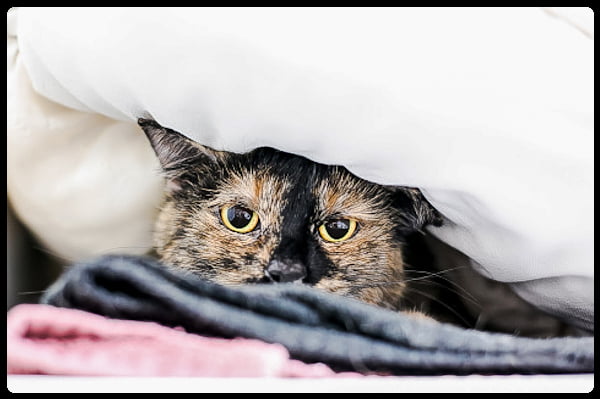
Domestic cats' lack of understanding of activities and objects in the human world makes them nervous
Domestic cats' lack of understanding of activities and objects in the human world makes them nervous. Photo: Pixabay.

But the original version of this proverb, from its first appearance in the 16th century until the end of the 19th century was, "Care killed the cat".

Care meaning anxious

In this saying, the word "care" means to worry about or to be anxious about something or other. It points to the possibility that cats could become so anxious and worried about something that it could even kill them. And this, apparently, used to be a belief by many people back in the day when the saying was first created.

And interestingly, this concept of worry killing cats is being revisited by veterinarians. Perhaps it's being revisited in terms of the fact that anxiety in domestic cats can harm their health which can lead to on occasions a serious health problems and even death.

But apparently, about 25% of cat owners surveyed in a 2008 study believed that their cat was incapable of feeling anxiety or sadness. Times have changed thanks to the internet I would say which has educated many cat owners. It is believed now that cats can at least experience the basic emotions that humans experience which includes anxiety or sadness.

And if asked today, scientists would agree that the old version of the proverb is to a certain extent true. Anxiety does present as a serious and real affliction for many domestic cats.

Anxiety is defined as a fear of something that is not currently happening. And you will find that there are, today, some anti-anxiety drugs which have been developed for humans which can be used on cats off-licence. Although, we are still unsure as to whether domestic cat feels the same kind of anxiety that humans feel but we are sure that feline anxiety is similar to human anxiety.

Elavil for anxious cats sometimes. Last resort.
Elavil for anxious cats sometimes. Last resort. Image: MikeB

Interestingly, in the study I mention, more than 60% of cat owners thought that domestic cats can be jealous. Almost 20% of the participants thought that cats can feel the emotion of embarrassment and more than 20% believed that cats can feel shame. Around 35% believed that cats can feel guilt and 40% were sure that cats experienced grief. About 60% thought that domestic cats experienced empathy.

Home range issues

The most common cause of anxiety in cats is to worry that their home range i.e. their territory is about to be invaded by other cats in the neighbourhood. This might apply to full-time indoor cats when looking out the window into the back yard.

Or they might feel this anxiety when living in a multi-cat home and where their territory is very compressed. Under these circumstances home ranges overlap a lot and there is a greater possibility for cats to develop anxiety because of intrusions into their home range.

When Dr. Jon Bradshaw conducted a survey of 90 cat owners in suburban Hampshire and rural Devon in 2000, the participants reported that almost 50% of their cats regularly fought with other cats. They confirmed that 40% of the cats were fearful of cats in general.

He states that he has a colleague, a veterinary surgeon, Rachel Casey, specialising in cat behavioural disorders who regularly diagnoses anxiety and fear. She believes that these emotions are main factors driving cats to urinate and defecate indoors outside of the litter box.

Forced to live with cat they don't trust and owner absence

As about half of domestic cats on that survey suffer from anxiety the old adage that I mention above carries some truth. And this leads to inappropriate defecation and urination inside the home. When cats defecate on bedsheets which by the way happened to my ex-wife's cat after my divorce, the cat is desperately trying to mingle their own smells with their owner's smells to establish ownership. 

It can be reassuring for a cat to do this. In my ex-wife's case I don't think this was about ownership of space but more about anxiety about her absence. Although she had introduced a new cat to the home which would have probably compounded the matter.

The stress of being forced to live with a cat or cat that they don't trust can affect a cat's health. The classic illness caused by stress is cystitis which veterinarians call idiopathic cystitis because there is no apparent cause of it.

66% urination problems

Dr. Jon Bradshaw tells me in his book Cat Sense that "As many as two thirds of cats taking to vets for urination problems-blood in the urine, difficult or painful urination, urinating in inappropriate places-have no obvious medical problems, other than inflammation of the bladder and intermittent blockage of the urethra by mucus thereby displaced from the bladder wall. The factors triggering such episodes of cystitis are therefore psychological."

Lack of understanding

When you think about it, there are a lot of things about the human world that domestic cats are going to struggle to understand because they are human. They can become acclimatised to them but constantly fail to understand them.

Certainly, new events and activities can make them anxious because of this failure to understand.

It's a reminder that we are different species and that our relationship as is an interspecies relationship and therefore quite special.

There are numerous activities which occur throughout the day and throughout the year which can cause anxiety and which are exclusively human in nature such as fireworks, delivery vans outside, the doorbell going off, the hoover being used and so on and so forth.

Owners aware

I think based upon this article that many cat owners should really be switched onto the possibility that their cat companion is going to stressed at some stage of their lives and they should look to the causes, the most common of which, as mentioned, is another cat or cats.

Wednesday, 28 June 2023

Humans coexisted with dinosaurs for a short time

A new study has decided that the ancestors of today's humans coexisted with dinosaurs for a short time. A discussion about this topic has been ongoing for a long time. The argument was that the mass extinction event that wiped out the dinosaurs took place before humans evolved but that assessment appears to have been overridden by this new study.

Humans coexisted with dinosaurs for a short time
Image: MikeB

A team of palaeobiologists employed statistical analysis of fossil records to conclude that placental mammals originated before the mass extinction event which was the impact of a large asteroid into the earth in the area of the Gulf of Mexico as I recall.

It's believed that after the asteroid impact placental mammals diversified and evolved rapidly perhaps facilitated by the loss of competition from dinosaurs.

The lead author is Emily Carlisle of Bristol's School of Earth Sciences who said:

'We pulled together thousands of fossils of placental mammals and were able to see the patterns of origination and extinction of the different groups. Based on this, we could estimate when placental mammals evolved. Unfortunately, we don't know what our placental mammal ancestors would have looked like back then. Many of the earliest fossils of placental mammals are quite small creatures such as Purgatorius – an early ancestor of primates – which was a small burrowing creature a bit like a tree shrew. 'So, it's likely that many of our ancestors were small and squirrely."

The study's co-author, Daniele Silvestro, of the University of Fribourg, added:

"The model we used estimates origination ages based on when lineages first appear in the fossil record and the pattern of species diversity through time for the lineage."

Up until the research fossils of placental mammals had only been found in rocks longer than 66 million years old which is when the asteroid hit the planet.

Comment: the research conjures up imagery of early humans fighting with dinosaurs. My mind goes to the Jurassic Park films. It appears that something similar may actually have happened.

Note: the first true cat species first evolved around 25 million years ago which was well after the dinosaurs had become extinct.

Wednesday, 18 January 2023

Boar-cat

'Boar-cat' was an early name for a male cat. An alternative name was 'ram-cat'. Both were replaced by 'tom-cat' in the 18th century, with the spelling now normally being 'tomcat'. You can go back further to medieval times (500-1500 AD) when tomcats were called 'Gyb' which was a shortened name for Gilbert which is why it is capitalized in contrast to tomcat which is not.

The 'painting below' is by an AI computer on instructions to paint a 'medieval scene with cat'. I think the result is pretty damned good:

Cat in a medieval scene
Cat in a medieval scene as painted by DALLE E an AI computer.

Gyb was a generic name but it could also be a given name to an individual cat. And there were variations on the name such as 'Gibbe' and 'Gybbe'.

A Scottish poem from the late fifteenth century by Robert Henryson goes:

"When two mice are on a table-top,
Barely have they drunk once or twice
When in comes Gib Hunter, our cat."

Monday, 9 January 2023

Cat owner's in medieval England advised to keep cats out of the bedroom

The French adage "plus Γ§a change" comes to my mind immediately.  It is a phrase which means that things don't change because basic human nature does not change even over thousands of years.

Medieval bedroom with woman and her cat
Medieval bedroom with woman and her cat. Photo-edited pic by MikeB.

And so back in medieval times (500-1500 AD) a well-known book which can still be found on Google, "Boke of Nature", advises in the strongest terms to keep domestic cats out of the bedroom:
"Dryve out dogge and catte, or els geve them a clout"
I guess you can understand it but it must mean:

"Drive dogs and cats out of the bedroom and if they enter hit them!"

Nice. A bit unfriendly to say the least. 

There is a strange medieval story of a knight and a lady he loves. She has a cat companion. She rejected the knight's advances. He goes to her bedroom at night in disguise. Her cat scratches him. She softens as a result and becomes his mistress but he refuses to marry her because he is scared of her cat! 

Some knight of the realm πŸ˜’. Lacking a bit of courage. Although the story is very modern in that the woman has the cat and the man appears not to be very keen on them.

The debate about domestic cats in bedrooms continues. I expect it has been a firm discussion topic since the domestic cat was imported into Britain by the Romans!

The best solution is compromise. Allow cats into the bedroom as it is so important to them. It is a major part of their home range. Don't deny them access. 

Make a nice, warm bedding area for your cat in the bedroom full of delicious cat owner smells and hope that she uses it. I understand the difficulties as cats disturb sleep but you get used to it. It is one of those human behaviour adaptations that cat caregivers have to transition to.

Source: Medieval Cats by Kathleen Walker-Meike.

Wednesday, 14 December 2022

Fertile Crescent confirmed as place of origin of domestic cat MU study finds

This is a new study that may interest some people. It basically confirms earlier studies and/or hardens up the theory that wildcat domestication first occurred in the Fertile Crescent, up to 12,000 years ago,  and they were transported to other parts of the world by their owners. Domestic cats might still be described as 'semi-domesticated' because of their ability to switch to a wildcat-like behaviour when allowed to roam outside the home except for the fact that they are socialised to humans.

Similarity in appearance is still evident after 10,000 years. Image: MikeB

Below is a summary of the study from a report from the University of Missouri. The scientist, Leslie A. Lyons, a feline geneticist and Gilbreath-McLorn endowed professor of comparative medicine in the MU College of Veterinary Medicine, was the study leader and author.

Domestic cats are thought to have originated from the wildcat species, Felis silvestris, which still exists today. The domestication of cats is believed to have begun when humans settled in the Fertile Crescent, the region surrounding the Tigris and Euphrates rivers in the Middle East. Cats were attracted to the settlements because of the presence of rodents, which were a source of food for the cats.

Fertile Crescent location where wildcat domestication first occurred.
Fertile Crescent location where wildcat domestication first occurred. Image: MikeB based on one in the public domain as assessed.

The new study at the University of Missouri used DNA analysis to examine the genetic makeup of cats from the Fertile Crescent area and other parts of the world. The researchers found that the genetic makeup of the cats in the Fertile Crescent was similar to that of wildcats, suggesting that the domestication of cats likely began in this region. The researchers also found that as humans migrated to other parts of the world, they likely took their cats with them, resulting in the spread of domesticated cats to other parts of the world.

Fertile Cresent
Another map of the Fertile Crescent. Image in public domain.

Domestic cats, like many other domesticated animals, have evolved to live and thrive in close association with humans. However, unlike other domesticated animals such as dogs, the domestication of cats has not resulted in significant changes to their natural behaviors. Cats are known to be skilled hunters and are able to take care of themselves in the wild, making them "semi-domesticated" animals.

The study at the University of Missouri used genetic analysis to provide evidence for the theory that cats were first domesticated in the Fertile Crescent region of the Middle East and were later transported by humans to other parts of the world. The researchers found that the genetic makeup of cats in the Fertile Crescent was similar to that of wildcats, suggesting that the domestication of cats likely began in this region. As humans migrated to other parts of the world, they likely brought their cats with them, resulting in the spread of domesticated cats to other parts of the world.

Monday, 9 May 2022

Cat coats tabby - all about, nothing left out

tabby cat
Cat Coats Tabby - Mackerel Tabby cat Chihiro - photo copyright fofurasfelinas reproduced under a creative commons license

Introduction - history


The tabby markings/color
is probably the most common, in either domestic cats or wild cats (e.g. Scottish wildcat). When cats breed randomly over a long period of time, apparently the coat color and pattern tend towards brown mackerel tabbies with green eyes (the most common "phenotype" - meaning the observed expression of the genetic make-up).

RELATED: Why are tabby cats so common?

This indicates a genetic predisposition towards what is probably the most efficient coat color/pattern in respect of the cat's survival. There are three tabby patterns: the classic blotched pattern, the striped or mackerel pattern, and the spotted pattern. The Bengal cat for example can have a spotted tabby or blotched coat, while the Egyptian Mau has a naturally occurring spotted tabby coat - the only naturally occurring spotted domestic cat it is said. 

The agouti ticked coat (the Abyssinian cat has the classic ticked coat) is a special kind of tabby coat. 

The Abyssinian has a special tabby coat. There are few markings unlike the usual tabby coats that can be spotted or blotched. This picture shows the banded hair strands. This photo is published under a Wikimedia Commons license. Author: Martin Bahmann 


As mentioned, you can see the tabby coat in wild cats such as the African wildcat and American Bobcat for example. However, I don't recall seeing a wild cat with what the cat fancy calls the "blotched" tabby coat. All wildcats appear to have spots and/or stripes or no tabby pattern. The blotched tabby appears to be a creation of the cat fancy or at least it has been "developed" and enhanced by the cat fancy (cat breeders). 

Tabby cat from Ancient Egypt (not far from Saudi Arabia) from 1500 CE. Picture in public domain.

Dr. Desmond Morris, the great zoologist and writer, tells us that it is believed that blotched tabbies arose first in Britain in the Elizabethan era. As you can see, they arrived very late during the evolution of the domestic cat. For the first 2,000 years or so or more all tabby cats were spotted/striped (broken stripes) tabbies and all domestic cats were spotted tabbies. And therefore, all domestic cat during the era of the ancient Egyptians were spotted/striped tabbies.

Dr. Morris says that the blotched tabby became a winner. In other words, a favourite and he is not sure why they did so well. Perhaps they were more healthy or more fertile than the other forms of tabby cat or perhaps they had an unusual level of aggressiveness or assertiveness. Perhaps people just like them and informally bread them?


Development of the blotched tabby domestic cat. My thanks to the scientists of the study:  The palaeogenetics of cat dispersal in the ancient world.


Today, the blotched tabby is the most common form of tabby coat and the striped tabby has gone into somewhat of a decline. Of course, nowadays the tabby coat is just one of many types of coat that have evolved during domestic cat evolution. However, Dr. Morris reminds us that genetically and in reality all domestic cats are tabbies. If they don't appear to be tabbies it is because the tabby pattern is masked by the other non-tabby colours.

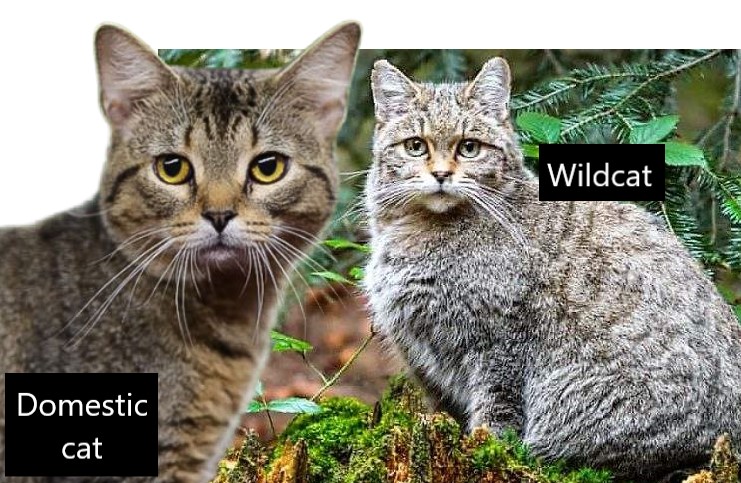
African wildcat compared with domestic cat. Image: MikeB from images in the public domain.

Of course, the tabby pattern comes from the original domesticated wildcats. The North African wildcat has a week tabby pattern. And if we want to visualise the early domestic cats all you have to do is look at today's African wildcats. From paintings created in ancient Egypt we see that the Egyptian cats had light or broken stripes. When they were exported over thousands of years to other parts of the world including Europe, the cats began to hybridise with their European counterparts and the result was a full-tabby coat.

Tests have shown that when the week-tabby European and African wild cats were experimentally crossed the hybrid kittens developed coat patterns which were much closer to the full-tabby pattern of modern domestic cats according to Dr. Desmond Morris. I have quoted him verbatim.

Ginger blotched tabby
Ginger blotched tabby. Photo: Pixabay.

All tabby cats have the classic M marking on the forehead in varies styles and disguises.

An example of a purebred and pedigree tabby cat would be the American Shorthair.  This breed looks particularly stunning in silver tabby. Another example of a beautiful purebred Maine Coon tabby can be seen by clicking on this link. The tabby pattern is often seen in Maine Coon cats. The cat associations allow a wide range of Maine Coon cat coat types (you'll see a great tabby MC on this link). There are some classic tabby patterns on wild cats. A good example is the tabby coat of the wildcats. These cats look very much like domestic cats as they are the wild ancestor of today's domestic cat.

Origin of Name

It is thought that the word, "tabby" originates in the appearance of silk sold in Baghdad (the Attabiyah region). This region must have been known for selling silks that had a striped appearance (watered - waved - silk) as incorporated into the name. Attabiyah is reference to the Latin attabi, and later the French tabis, which means, as I understand it, watered silk. As the striped and marbled tabby cats have the same general appearance, the word "tabby" was used to describe the coat.
cat coats tabby - tabby cat
Cat Coats Tabby - Mackerel Tabby cat Chihiro - photo copyright fofurasfelinas reproduced under a creative commons Attribution-NonCommercial-NoDerivs License

The Genes

As mentioned, the wild cats have tabby coloration and patterns and the domestic cat is descended from the wild cat (see a comparison between the Scottish wildcat and domestic tabby). The pattern has 2 elements to it. (1) There will be a group of hairs in which the individual hairs have bands of color running horizontally up the hair strand. One band will be yellow and the next black. These hairs form the background color upon which the pattern is overlayed by the second group of hairs. The commonly spoken of "Agouti" gene (A) creates this banding pattern on the hair shafts. The banding on the hair shaft is due it is thought to a reduction in the production of the pigmentation granules or the production of a different and yellow pigment. This results in fewer granules that are spread more thinly throughout the hair follicle to give the beige/yellow looking color.

The pigment producing the black band in the hair shaft is called eumelanin and the yellow pigment is called phaeomelanin.

Tabby Hair Strand. Image: MikeB.


If the band near the surface is beige you get the light brown broken effect and if the black banding is near the top the black is broken up by the beige banding lower down. (2) The other group of hairs will be black because the yellow banding referred to above will have been reduced (repressed) to the base of each hair or removed entirely. This group is seen as the spots or stripes or blotchy patches of black or brown that forms the patterns seen in the pictures. This effect is a result of the presence of the Tabby gene (Mc/mc), which is present in all cats and so are the markings but often sufficiently suppressed as to be invisible.

I know a small classic tabby that has also solid black hair in swathes, and also black hair with one band of beige near the surface which creates a speckled look on black. All these combinations are mixed together in various proportions and in varying sized clumps to produce the tabby pattern. The pattern that we readily see is due to the alternation of solid color (black fur) with the banded fur to create a pattern as mentioned above. It is the Primary Tabby gene (Mc) that dictates how the pattern will shape up for the individual cat.

tabby cat
Cat coats tabby - Tabby cat. This is a great photograph of a tabby cat. I just had to put it on this page. It is reproduced under a creative commons license.

There are several varieties of tabby markings and of course as mentioned an almost inexhaustible spectrum of colors, contrasts and pattern variations particularly in purebred cats where the appearance of the cat is of paramount importance.

Update 12th January 2011: See an article on red tabby cats and a nice picture of a Maltese red tabby.

Torbie

The torbie is a mix of tabby and tortoiseshell. Here is an example:

Gemma: Torbie Siberian Cat. Photo copyright Helmi Flick

Read about torbies by clicking on the link below:

  
Tabby Cat Picture

There are a lot of tabby cat pictures on this page! People search for "tabby cat picture" so here is one of the best of a rescue cat by Giane Portal on Brazil. This is a classic blotched grey tabby cat - perfect example. You can see an orange tabby cat picture or two on this page.

Dominique
Dominique - photo copyright Giane Portal

Mackerel Tabby

silver mackerel tabby cat
Cat Coats Tabby - Silver mackerel tabby cat - photo copyright Helmi Flick

red-and-cream-mackerel-tabby-cats
Cat Coats Tabby - Cream and red mackerel tabby cats - photo copyright Helmi Flick

red-mackerel-tabby-cat
Cat Coats Tabby - Red mackerel tabby cat - photo copyright Helmi Flick

brown-mackerel-tabby-cat
Cat Coats Tabby - Brown mackerel tabby cat - photo copyright Helmi Flick

blue-and-brown-mackerel-tabby-cats
Cat Coats Tabby - Blue and brown mackerel tabby cats - American curl cats - photo copyright Helmi Flick

The type we probably are most familiar with is the mackerel, stripped tabby. This is considered the wild type of tabby pattern. The genotype (the genes producing the black tabby coat) is A (agouti) + B (black) + D (dense coloration) + Mc (tabby gene).

Breeders like high contrast striping that is nice and evenly spaced and the stripe should be continuous. The Toyger has this. The Toyger also has a beautiful base or ground color that is incredibly warm (orange almost). The base color comes from the color of the agouti band on the individual hair strand. The warming up of the ground color is due to selective breeding in modifier genes (rufus modifiers). Click on the link to go to a pictures of cats.org videos of cats many of which are fundamentally tabby cats (YouTube, channel is broadsurf the YouTube name of Michael at Picture of Cats).

Classic Tabby

blue classic tabby cat
Blue classic tabby - photo copyright Helmi Flick

red classic tabby cat
Red classic tabby - Maine Coon - photo copyright Helmi Flick

cream classic tabby cat
Cream classic tabby - photo copyright Helmi Flick

brown classic tabby cat
Brown classic tabby - photo copyright Helmi Flick

silver classic tabby cat
Silver classic tabby cat - This as you might have guessed is an American Shorthair cat. I have a post dedicated to the American Shorthair tabby cat. The silver is due to the Inhibitor gene I, which inhibits the production the yellow Agouti banding leaving the black to contrast more starkly with a gray/silver background.

The genotype (the genes producing the black tabby coat) of the classic blotched tabby cat is A (agouti) + B (black) + D (dense coloration) + mcmc (tabby gene). The difference to the mackerel tabby is the existence of the mc allele (allele = one of a pair of genes).

Spotted Tabby

brown spotted tabby cat
Brown spotted Tabby - Bengal cat - - photo copyright Helmi Flick. Bengal cats are known for a very high contrast marbled pattern, see some superb examples by clicking on this link. Spots are another form of tabby pattern. You can see this beautifully expressed in the Bengal cat and/or, for example, the Ocicat.

blue spotted tabby cat
Blue spotted tabby cat - - photo copyright Helmi Flick
cream spotted tabby cat
Cream spotted tabby - Exotic Shorthair cat - photo copyright Helmi Flick


silver spotted tabby cat
Silver spotted tabby - an example of the presence of the Inhibitor gene I - a Bengal cat - photo copyright Helmi Flick.

Research is still being carried out on the genetics behind the spotted tabby coat. It may be due to a modifier gene on the mackerel tabby. The striping of the mackerel tabby can break up and if that is captured and bred into the cat you'll get spots. In the Ocicat it seems that the effect is due to a dominant modifier of the blotched classic tabby pattern. Click on the link to see a video of the Ocicat on YouTube (this video is part of Pictures of Cats.org)


Ticked Tabby - Abyssinian Tabby


silver-ticked-tabby
Cat Coats Tabby - Silver ticked tabby - Abyssinian cat - photo copyright Helmi Flick

red-ticked-tabby
Cat Coats Tabby - Red ticked tabby - photo copyright Helmi Flick

brown-ticked-tabby
Cat Coats Tabby - Brown ticked tabby - photo copyright Helmi Flick.

Robinson's genetics says that the gene that produces the Abyssinian ticked coat is not the same gene as the tabby gene producing the classic and mackerel. They call it the "ticked gene". The authors say that the Abyssinian cat's appearance is a mutation of the normal tabby. The tabby pattern occurs on the head, legs and tail and very faintly elsewhere on the body. Breeders like to reduce the pattern further by careful breeding. The most frequently seen Aby color is the ruddy (red) - middle picture above - called the "usual". Breeders breed in a warmer color.

The full set of genes producing the well known Abyssinian coat are: AA (Agouti) - B (black) - D (dense coloration) - TaTa (ticked gene).

The tabby cat locus maps to the feline chromosome B1. It seems possible that the tabby gene has a homologue (common evolutionary origin) on human chromosome 8 or 4. (src: http://www.pubmedcentral.nih.gov/)

Interesting

This is an interesting bit of information about the tabby cat as camouflage, which comes from Desmond Morris's book "Catwatching". It had been proposed by a nineteenth century naturalist (I presume) that when a tabby cat is curled up she/he looks a bit like a "coiled snake". Once again this is a form of mimicry, one of a number of examples of the cats mimicry of the snake as an act defensive. Read about a cat hiss as another example.

A Torbie is a mixture of tabby and tortoiseshell. An example of tortoiseshell is the black tortoiseshell or just plain old tortoiseshell cats (this page has great pictures). Some people think the tabby cat is a cat breed.


See a Tabby Persian cat picture by Helmi Flick

Cat coats tabby - Photographs not captioned are copyright Helmi Flick and as follows:
  • Top is a classic tabby
  • 2nd is the mackerel tabby
Cat coats tabby - Sources:
  • Messybeast
  • Cat Fanciers
  • Beth Hicks
  • Robinson's Genetics
From Cat Coat Tabby to Cat Facts

Wednesday, 30 March 2022

Respect Your Cat Day 2022 originates in King Richard II's edict of 1384?

This is rather strange but some authors online are connecting this year's Respect Your Cat Day with Richard II and an edict that he made in 1384 in which he condemned eating cats. It was an early form of respecting the cat. You can see from the short clip from a book listed by Google that the peasants of the time harboured a lot of resentment towards King Richard and they took it out on cats. They killed and ate them by the thousands according to this extract. At the time there were food shortages. They called the King "the royal cat".

I do not know if this is true. However, it is a fact of history that in 1381 there was the Peasants' Revolt which was the first crisis of Richard's reign. He rode out to meet the rebels who were led by Wat Tyler. Tyler was killed and the revolt was crushed. Afterwards Richard began to take control of the government himself, building a group of unpopular favourites.

Richard II of England
Richard II of England. Image: Wikipedia.

The extract that I mention begs the question whether peasants of the time i.e. the workers of the day, ate domestic cats. Actually, at that time the domestic cat would have been an outdoor cat and probably better described as a community cat, a bit like the cats you see in developing countries today. It also begs the question as to whether Richard II liked cats and owned a cat. I can't find a record of this but it seems possible bearing in mind his informal title (if it is true).

If the peasants were starving, it is reasonable to suggest that they killed cats and ate them. It would be an early example of cat meat.

RELATED: 10 countries where they eat cat and dog meat (2020).

Today, more than 600 years later, cat meat is still consumed in more than 10 countries in the world. And I am referring to domestic, stray and feral cats. Yes, someone's pet is being killed and eaten somewhere on the planet as you read this, probably.

Exotic SH
Exotic SH - bicolor. The flat-face distorts the bone structure causing issues such as teat duct overflow. This is not respecting the cat. Image: video screenshot.

This, of course, goes very much against respecting the cat. Respecting the cat means allowing the domestic cat to behave as naturally as possible. This will lead to contentment. Respecting the cat means relating to your domestic cat is a cat and not a baby. Respecting the cat means not breeding unhealthy cats. And it means caring for feral cats and not just killing them as they do in Australia in the many thousands Humankind should care for feral cats because we put them there through our carelessness.

Featured Post

i hate cats

i hate cats, no i hate f**k**g cats is what some people say when they dislike cats. But they nearly always don't explain why. It appe...

Popular posts