Showing posts with label bicolor cat. Show all posts

Sunday, 27 August 2023

Are bicolor cats rare, friendly, hypoallergenic?

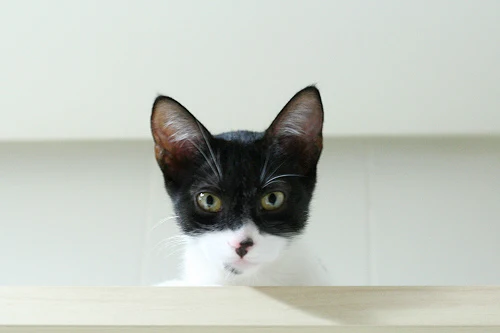
Tuxedo cats are bicolor cats. This is my darling deceased female. Image: MikeB

Bicolor cats are cats with a coat of two (as in 'bi') colors: white and another colour such as black or ginger. And the 'other colour' can have tabby markings. 

They can be moggies (random-bred cats) or purebred, pedigree cats. It does not matter which. They are common and therefore not rare. Neither are they hypoallergenic but they are friendly if they've been socialised properly and treated well.

No domestic cat is hypoallergenic as the Fel D1 allergen is produced by all domestic cats. Purina LiveClear works pretty well to make a cat acceptable to a person allergic to cats.

'Hypoallergenic' means not producing an allergic reaction in people. About 10% of people are allergic to cats.

The white fur in bicolor cats is caused by the presence of the piebald aka white spotting gene, which affects the migration of pigment producing cells (melanocytes) in the skin during the development of the embryo. 

Where there are no melanocytes there is no melanin in the hair strands. White fur does not contain pigment namely melanin.

It is white because the light from sun or room light passes through it. White light is a mixture of all the colours of the rainbow.

Melanin is a brown/black. If it is diluted, black becomes blue grey and red becomes cream and so on.

The experts rate bicolor cats from 1 to 10 depending on the amount of white fur. Level 1 is black and no white fur while level 10 is all-white. The cat in the picture is about level 4.

If you have a question, ask in a comment and I'll be pleased to respond. I always check comments as I get so few! :)

Level 9 bicolor Cornish Rex
Level 9 bicolor Cornish Rex. Image in the public domain.

Saturday, 21 January 2023

Father and daughter 'wear' the same 'mask'

My reading of the genetics behind this father and daughter cat looking as they do (very cute and very rare) is that they have the white spotting gene or piebald gene in their genetic makeup and it has caused this highly unusual Zorro mask to develop. I guess it is just by chance that the white spotting gene had this effect upon the way the pattern developed. I don't think that there is any special genetic mutation going on here.

Father and daughter 'wear' the same 'mask'
Screenshot.

The white spotting gene normally simply results in a standard bicolour cat. These two are bicolour cats but the markings are remarkable. Normally the markings are just black-and-white blobs or a white background with markings being created by darker coloured fur. An example of a bicolour cat is the Harlequin. I have a page on bicolor cats. Please click on the link below.

Solid and white cat coats.


Monday, 9 May 2022

Cat coats: solid-and-white - bicolor cats

black and white cat
Cat Coats Solid and White - Bicolor - photo copyright fofurasfelinas


This is another posting on cat coats. This time I discuss the impact of the white spotting gene on "solid" colored cats other than Tuxedo cats, which I have already discussed on this page. Tuxedo cats are very common and specific in their coat pattern so I've dealt with them separately. Both are bicolor cats meaning a cat coat of two colours, white and another solid colour.

Bicolour development - white spotting gene. Image: Sarah Hartwell.

The particular effect that the white spotting gene has on any one cat dictates the spread of white fur on the cat (or put it another way it restricts the spread of color). The cat fancy has given names to the patterns caused by this gene, which by the way is also called the piebald gene. It is considered a "semi-dominant" gene.

Bicolour faces white spotting gene. Image in public domain.

White spotted cats are one of the most common cats. The white spotting gene (represented by the letter "S" in the science of genetics) can change the appearance of any colored cat including tabby cats or tortoiseshell cats or a combination of the two (torbie). [See cat coats tortie and white]. When it affects a tortoiseshell cat, the cat is called a calico cat in the States.

Bicolours. The chart is by Sarah Hartwell of messybeast. Many thanks.

RELATED PAGE: White spotting gene charts.

A fine example of a cat with a solid and white coat is the Turkish Van (high grade spotting - see below). This has, of course, the "Van" pattern. Van is a town in the South east of Turkey, where the Turkish Van originally came from (including adjacent regions).

Another example of a well-known cat breed with a "solid and white coat" is the Japanese Bobtail. The Japanese Bobtail has a Bicolor pattern in both "solid and white" and calico (which is tortoiseshell and white mentioned above).

bicolor cat
Bicolor cat photo by tanakawho (this photographer is well known - see more of his work here plus the work of 2 other fine photographers). Picture reproduced here under a creative commons license.

I discuss, in brief, the workings of the piebald gene on the Tuxedo cat page as well as here. The effects of the piebald gene can be seen to varying degrees. The amount of white dictates whether the pattern is a grade 9 (almost total white with the colored fur limited to a few spots). This is called high grade spotting.

At the other end of the spectrum at grade 1 there is a very small amount of white. This is called low grade spotting. When the cat is low grade the genotype (genetic makeup in relation to the cat's coat) is normally heterozygous represented by the letters "Ss". Conversely when the coat is high grade (lots of white) a spotted cat is generally homozygous "SS".

Black and white bicolor Scottish Fold kitten from Russia (Siberia). Photo (excellent):  Анатолий Кузнецов.

The presence of the piebald gene results in white fur by causing special embryonic cells to behave in a defective manner. These cells are called "Melanoblasts" and they become the cells of the cats body that produce the granules of pigmentation that are embedded in the individual hairs. During the embryonic stage these cells migrate from the spine area. They fail to migrate properly and fully causing parts of the body to be without color. The wide variability of the effect of this gene is due, at least in part, to the presence of other unidentified genes called "polygenes".

The great Dr. Desmond Morris discusses bi-colour cats in his book Cat World. He tells us that such patterns are most common in non-pedigree cats. But of course, you will see this coat type in pedigree cats as well. It depends on the breed standard is to whether they are allowed or not. In the early days of the cat fancy the bi-colour cat was less likely to be accepted because they felt that they made a pure-bred animal look like a moggy.

This was prejudice against the coat but it was more likely to be accepted if there was some sort of distinguishing factors about the bicolour coat such as an attractive symmetry or the distribution of the colour was interesting.

In the early days of the cat fancy the black-and-white coat was referred to as a 'magpie cat'. And sometimes the bicolour cat is called a parti-colored cat. You will see "parti-colored" spelled in different ways. Apparently bicolour cats only attained championship status within the show cat fraternity in 1966.

You will see bicolour cats in longhaired and shorthaired cats and in many cat breeds such as the American Shorthair, British Shorthair, Devon Rex, Cornish Rex, Japanese bobtail, Maine Coon, Manx and Persians. These are just examples. There are others.

Here are some photographs of the solid and white coat pattern:

Cream and white - photo:
copyright Helmi Flick


Cat Coats Solid and White - Turkish Van - Photograph copyright Lazy_Lightning


Cat Coats Solid and White - Black and White Van pattern with a lot of white (grade 8 perhaps) - photograph copyright Helmi Flick.


Black with white (more than a Tuxedo). Photograph copyright Helmi Flick.


Cat Coats Solid and White - This is another black-and-white cat (hairless cat). This demonstrates how the white spotting gene affects the skin color as well. Perhaps more accurately it is the almost invisible downy hair strands near the skin which are pigmented.


Perhaps a more accurate description for this cat, a Sphynx Cat (or Sphynx-like cat) would be Black and Pink! Photograph copyright Helmi Flick.

Cat Coats Solid and White - Sources:
  • Beth Hicks
  • Messybeast - Sarah Hartwell

From Cat Coats Solid and White to Cat Facts

Saturday, 29 May 2021

Ritualistic shampooing accepted by patient domestic cat standing on hind legs

This patient domestic cat knows what he is about to receive by the look of his patience as he waits to be shampooed. It seems to be a ritual. The cat politely complains but accepts the shampooing. It is very cute because it appears that the owner has done this a lot and her cat has learned to accept it without question except for the faint complaint.

Cat in Asia is shampooed standing up on two legs
Cat in Asia is shampooed standing up on two legs.

It is unusual to believe that you have to shampoo your cat regularly. In this instance it maybe because the cat is a community cat living outside a lot with the greater possibility of getting dirty. But I think it is more to do with the attitude of the woman caring for her ginger bicolor cat. She is treating him as a child. You can see her washing his bottom and tail as if she is washing the bottom of a baby. There may be a culture in that country to do this. She may be doing it to get rid of fleas. The better method would be to use a flea comb twice per day. Healthier for the cat and more effective.

It is nice that she has this close bond with the cat but she needs to be aware of the unnaturalness of bathing a cat so often (if that is the case). It can dry out the skin and it certainly removes all the cat's scent. If there are other cats who are friendly with this one, they will no longer recognise him for a while. There may even be a fight as a consequence.

Note: This is a video from another website. Sometimes they are deleted at source which stops them working on this site. If that has happened, I apologise but I have no control over it.

Friday, 21 May 2021

AITA for adopting a cat that has a penis on his face and naming him Richard?

AITA is an acronym Am I the Asshole and in this instance a man posted the title to this page on the reddit.com website. He tells the world on that high hitting website that he adopted a rescue cat who had been left on the shelf. Nobody wanted to adopt this cat because of the markings on his face and those markings look a little bit like an erect penis. 

AITA for adopting a cat that has a penis on his face and naming him Richard?
AITA for adopting a cat that has a penis on his face and naming him Richard? Photo: Imgur.


The fact that he adopted the cat was a good thing, but he called him Richard knowing full well that he would call him Dick for short. He then asked all the visitors to his reddit.com post whether he was an asshole in doing what he did.

It is interesting to note that the administrators of reddit.com have removed the picture but the headline is still there. The picture is above. Well, I have given this some consideration and I think he has been an asshole. I think he adopted the cat because he wanted to make him a celebrity and in doing so, he could become a minor celebrity himself. He wanted to live vicariously through his cat. A lot of people do that on the Internet; they achieve what I would call 'vicarious celebrity status' through their interesting-looking domestic cat companion.

The first problem is that he rescued the cat for the wrong reasons, in my opinion, but I am speculating and therefore it is not fact. Secondly, he did not have to ask the question on a social media website and he did not have to name him Richard. 

So, he did quite a lot of things which he shouldn't have done and in doing these things he disrespected his cat. He did not insult his cat for obvious reasons, namely that his cat did not know what was going on but that really isn't the point. If a cat owner disrespects their cat, he is doing the opposite to what he should be doing which is respecting the cat because out of respect flows excellent cat caretaking.

I would conclude that he is not ideal cat owner. A really good cat owner would not have done what he has done. Those three errors in judgement, as I would call them, would not have been made. Or if a good cat owner had adopted this cat because he was left on the shelf, they would have simply left it at that and loved him and cared for him without publicising his picture on the Internet and giving him an inappropriate name.

Sunday, 7 March 2021

Can cats be piebald?

Yes, cats can be piebald. In fact, they are very common. They are referred to as 'bicolour cats' or cats with a 'solid-and-white' coat. But the cat below is not common. Not by any stretch of the imagination. This cat is amazing. I think this rare cat is a piebald but a rare pattern.

Unusual bicolor cat
Very unusual, in fact strange, piebald coat. Photo: Facebook

The word piebald is an amalgam of 'pie' from magpie (a black-and-white i.e. two coloured bird) and 'bald' meaning a bald or white patch.

Unsurprisingly the gene that causes the piebald or bicolor coat is called the piebald gene. It is also referred to as the white spotting gene.

People ask if cats can be piebald because we are far more familiar with the word being used to describe a horse. You'll see the piebald coat pattern on many animals including dogs too.

The location of the white fur and how it migrates during development of the cat in the womb is governed by the piebald gene and how it operates on the migration of the melanoblasts from the neural crest to paired bilateral locations in the skin of the embryo.

Strange bicolor cat
Strange bicolor cat. Photo: Facebook

Sometimes the gene causes cats to be deaf and sometimes one eye may also have no pigment in the iris causing it to be blue. Blue eyes are caused by white light refraction and not pigmentation.

There is an amazing mainly white bicolour cat on the internet (see photo above). I have just written about her. She is very rare. But she is a piebald cat in my opinion although the pattern is incredibly unusual. There may be a polygene effect (multi-genes working together).

Black and white cat - a piebald cat
This is my late female cat.  A black-and-white. I loved her deeply.
Photo: MikeB

The coat looks genuine by which I mean the photo is not edited or the cat is not dyed. Yes, some people do dye their cats to make waves on social media.

Monday, 1 February 2021

Picture of a cat with an unsettling human face


Picture of a cat with an unsettling human face

There is not a lot you can say about this amazing cat. He is a bicolor. Looks like a solid red bicolor. He has a wonderful ruff as if worn on a human. His human appearance appears to be by chance and is mainly as a result of the fur pattern on the face which gives the impression of a moustache on a middle-aged man. We see Maine Coons selectively bred to have human facial expressions. But I don't believe that this is a purebred cat and is therefore random bred albeit a rare one.

Featured Post

i hate cats

i hate cats, no i hate f**k**g cats is what some people say when they dislike cats. But they nearly always don't explain why. It appe...

Popular posts
