Thursday, 24 November 2022

Dark tortoiseshell, Flossie, is world's oldest living cat at nearly 27

Her name is Flossie. A good name. She is a very dark tortoiseshell domestic cat living in Orpington, near London (southwest) with Vicki Green and Guinness World Records have bestowed upon her the award of the world's oldest living cat as at today's date at 26 years and 330 days old. Here they are:

Vicki Green with her Guinness World Record holder of oldest domestic cat at nearly 27
Vicki Green with her Guinness World Record holder of oldest domestic cat at nearly 27. Image: screenshot from Guinness video below.
Here is Flossie in closeup:

Flossie closeup
Flossie closeup. Image: screenshot from video.

Flossie is deaf and mostly blind. Ahh. I feel for her, but she is a beautiful companion for Ms Green. They get on well Vicki said. Flossie is only just a bit younger than Vicki. Flossie outlived her two previous owners!


Flossie has beaten an American cat to the record. Corduroy was 26 years and 300 days old when she died on May 27, 2016.

Ms Green said:
"I knew from the start that Flossie was a special cat. But I didn't imagine I'd share my home with a Guinness World Records title holder. She's so affectionate and playful, especially sweet when you remember how old she is."
Here they are with the certificate:

The certificate, Vicki and Flossie
The certificate, Vicki and Flossie. Screenshot.

And here is the YouTube video:


Tuesday, 22 November 2022

The negatives and positives concerning 'community cats'

The phrase "community cats" has a different meaning depending upon where they are. In the USA, for example, those feral cats which are managed by volunteers in TNR colonies are sometimes referred to as 'community cats'. They are quite nicely looked after, and they can live quite decent lives and indeed long lives. They certainly buck the image that some people describe regarding feral cats namely that they are very sick and live only for three years.

Community cat
Community cat. Image: in the public domain.

Developing countries

But community cats are more common in countries where there is a very laissez-faire or lax attitude towards cat ownership. I'm referring, without criticism, to developing countries and even those that you might consider to be developed such as India which is a kind of hybrid because certain parts of India are well-developed whereas other parts are underdeveloped.

But in India there are lots of community cats. Arguably, there are far more community cats than there are true domestic cats living under the caretaking of their owner. Community cats are cared for by the community as the term implies which means shopkeepers and anybody who wants to be involved.

Little or no veterinary care for community cats in developing countries

But they live pretty wretched lives a lot of the time. They are fed scraps and I guess sometimes crappy food and rarely decent well-balanced cat food. And I would suspect, too, that they are rarely taken to a veterinarian when they are ill. So, they don't get veterinary care.

Therefore, they die and a much younger age than they would otherwise if they were living with a caretaker.

Still better than feral

So, the upside for these community cats in places like India and the Far East is that they are cared for to a rudimentary level but no more. That's the plus point. It is better than being an abandoned feral cat, totally alone and surviving the elements in an urban jungle where they are likely to die young at about three years of age.

But the downside as mentioned is just a very rough life by and large without a proper caretaker.

TNR and community cats in developing countries

TNR is not that well adhered to in places like India or the Far East. It seems to me that the unowned cats in those places are not going to receive the benefit of volunteers involved in TNR programs.

I suppose TNR programs do exist in certain parts of India, but I would suspect that they are rare, indeed very rare. And this is why feral cats procreate unhindered in places like India and Pakistan and so on. They can procreate. They do procreate.

This exacerbates the unowned cat problem. These are stray and feral cats. And of course, as mentioned community cats. The attitude towards spaying and neutering in certain countries is too lax which means they have a perpetual abundance of stray and feral cats some of whom will become community cats because somebody wants to take care of them.

TNR developed countries

The best community cats are those as mentioned which are TNR colonies cared for by volunteers in countries like America. Although it must be said that TNR is controversial. In general citizens support it as it is the only way.

TNR volunteers are often or at least sometimes supported by the local authority through taxpayers' money supplied in a minimum way, but any money is effective in helping to support TNR programs. Donations are solicited to provide veterinary care.

And of course, TNR programs are designed to gradually stabilise and reduce the number of feral and stray cats in the community. And they want to reduce the size of the colony of cats in their care which they describe as community cats.

So, the most effective TNR programs put the volunteers out of work because over a long period of time, and it may take 30 years, there are no longer any feral cats to take care of.

Conclusion

In conclusion, the life of a community cat is better than a life of a feral cat in developing countries. And the same will apply to developed countries if volunteers manage TNR programs and look after a colony of feral cats. But the fact is that in developed countries community cats as mentioned do receive veterinary care

Health and welfare from desexing

Another point worth mentioning is that both spaying and neutering improves the welfare of female and male cats respectively. It improves the health of female cats and improves the behaviour of male cats and stops them or minimises the chances of them getting into fights during which they become injured.

Monday, 21 November 2022

Two New Jersey towns support TNR with one trying and rejecting a trap/kill policy

NEWS AND COMMENT: This story concerns a couple of New Jersey, USA towns. One of them is Bayonne, a city in Hudson County and the other is actually described as a borough and it is Matawan. The latter tried to introduce, in a ham-fisted way, a feral cat trap/kill program which backfired badly.

Matawan

The borough administrators introduced an ordinance which said that they were going to trap stray cats and if nobody claimed them within seven days, they would kill them. And in a badly mismanaged way, they said that the Monmouth County SPCA would do the trapping and killing without consulting with them in the first place. And secondly, they employed the local police force to distribute notices about their new but flawed campaign.
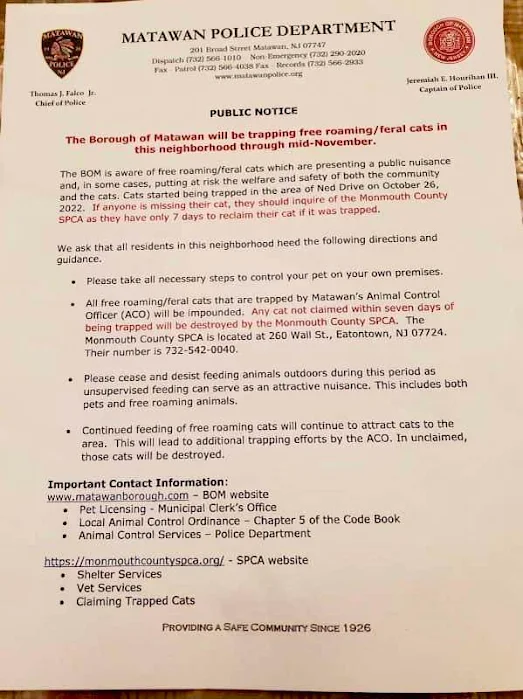
From Facebook.

It all blew up in their face when the SPCA complained bitterly that they hadn't been consulted and the public rebuffed them. The police had to make a statement to say that they weren't involved in the killing of cats. Clearly, the campaign did the police no favours as it damaged their reputation.

Anyway, the mismanaged campaign, organised by Scott Carew (as I understand it), the borough's business administrator together with the animal control officer and councilwoman Melanie Wang, was abandoned without any stray or feral cats being trapped.

They made a U-turn on realising their error and have decided to introduce a new ordnance which focuses on TNR (trap-neuter-release). That's the way to go. But it took the public and the SPCA to teach them that lesson.

Humane and ethical approach

The public are concerned about feral and stray cats. Some people hate them while others are more sensitive towards their needs. But in general, the public want feral cats dealt with humanely. They realise that careless human cat ownership put them there in the first place and secondly, they are sentient beings. The ethical way to deal with feral cats is TNR. It is the only current way, but it requires a good investment and the involvement of the local authority.

This leads me nicely to another story from the same state, New Jersey, which reports that Bayonne's city council has decided to continue with a TNR program which is managed by the New Jersey Humane Society.

Bayonne

They have consistently put in sufficient funds (it seems to me) to run the program. This is a commitment from the local authority to fund TNR and they're using somebody who they respect, Geoffrey Santini, the city's animal control officer who works at the New Jersey Humane Society, to organise the TNR program.

Mr Santini is described by Bayonne's Municipal Services Director Suzanne Cavanaugh as a "lovely gentleman, and he is excellent at what he does. He is a true partner with the city of Bayonne."

That's how it should be done in my view. You have a city council or county council who are focused on TNR to control feral cat numbers. They fund it consistently and they work with the best people to arrange and manage the TNR programs.

According to the report, in the Hudson Reporter, the city has consistently funded TNR and recently agreed to an addendum to the ordnance to add a further $25,000 to the program. The program commenced, as I understand it, in April 2021 when it was funded with taxpayers money amounting to $54,123.

Comment: perhaps local administrators are realising that TNR is the only way forward. It has its flaws according to ornithologists and others because in essence you are putting feral cats back on the ground where they can continue to prey upon wildlife. But patience is required and consistency. Armed with these two qualities TNR works if funded properly.

It needs to be as widespread as possible to be as effective as possible. It is the only way to deal with feral cats currently until something better comes out such as contraception (drug placed in food) which doesn't work well enough.

There are other instances of councils trying to trap and kill feral cats, but they almost invariably end up with a backlash from the public who complain because, as stated, the majority of the public are against the cruelty of trap and kill policies.

Domestic cats caught in trap and kill programmes

And there is always the potential for killing a person's cat companion. There are still places where there are indoor/outdoor cats, and you cannot tell the difference between a feral cat and an outdoor domestic cat (pre-TNR which ear tips ferals). You don't want to kill someone's pet because that would be a catastrophe and it would open the doors to a criminal charge against the local authority for criminal damage.

Saturday, 19 November 2022

Twitter on the brink of shutdown and it's going to affect animal rescue!

I'm being very speculative in this short article, but it occurred to me that Elon Musk's approach to staff management at Twitter may have a very detrimental effect upon animal welfare across the planet. 

He's been brutal in his takeover of Twitter which has resulted in some reports suggesting that up to 75% of employees have refused to take up his offer of working long hours and providing 'exceptional performance'. To him, only that would qualify as a 'passing grade' in his words.

Twitter has seen mass resignations following an email from Mr Musk, it has been claimed. Image: Getty Images.

And therefore, there's been a mass exodus of employees. It appears that he is risking losing his $44 billion which was the price of Twitter. Apparently, he overpaid quite substantially for the social media website which is relatively small compared to websites such as Facebook. 

As I understand it, it's about 10th in the league of social media sites by size. But it is influential, and a lot of animal welfare operations rely on it for effective communication and promotion.

Elon Musk seems to be unconcerned because he said that: "We just hit another all-time high in Twitter usage". But a lot of engineers have walked out and there is a possibility that understaffing Twitter will gradually undermine the functionality of the website. 

Things will start to go wrong because not enough engineers and developers are around to fix the ongoing problems.

It appears that Elon Musk has decided that Twitter is populated by lazy staffers. He wants to weed out anybody that he considers by his standards to be lazy and not contributing enough but is he being too brutal and direct?

He's offered three months' severance for those employees who want to leave. Over the weekend he is closing down the Twitter offices. Why is he doing this? I've heard on the news that he is frightened of a disgruntled employee sabotaging Twitter.

One employee, a tech writer called Gergley Orosz said that: "[It] sounds like playing hardball does not work. Of course, it doesn't."

It would be disappointing to lose Twitter. Firstly, I don't mind in the slightest, but it would negatively impact animal welfare I believe.

Friday, 18 November 2022

Greek stray cat's charm and loving personality compels British holiday couple to bring him home

Couple say a kitten "adopted them" after they found him meowing outside their hotel room in Greece. I say this sweet, Greek, stray, bicolour cat used his smarts and charm to compel the couple to adopt him 👍😎. That purr can be so persuasive.

Toni Czogalik, 23, and her boyfriend were on holiday on the Greek island of Rhodes in October 2022. There was a thunderstorm outside. And there was a small, six-month-old black-and-white kitten outside their hotel room as well and he was meowing to be let in. He was soaked through.

It's probably pretty clear that the thunderstorm frighten the cat and he was looking for some comfort and used his charm and persistence to adopt this British holidaying couple. 

Toni said:
"One night on holiday there was a thunderstorm, and the kitten came to hotel door crying and soaking wet. We looked after him for the night and ever since then he kept coming back to our room and wouldn’t leave us alone. "
They named him Nermal and decided to adopt him. The video explains the difficulties of doing this and also the persistence and intelligence of Toni in achieving her goal. 

She had to go to a veterinarian to get Nermal micro-chipped and vaccinated. They bought a cat carrier from a local pet shop and an ID bag and some treats for the journey to the UK. 

Nermal was then flown from Rhodes to Athens and then he travelled by boat to Italy from where he was driven to the UK to be reunited with Toni. 

He arrived on November 8 and settled in well as you can see from the video. Toni explains the hurdles she encountered but she was aware of them:
"It was really difficult, the first few days I messaged every single charity in Greece that dealt with cats. We first took him to the vet to find out if he was healthy and microchipped. He wasn’t microchipped, so they said he was definitely a stray. The vet then gave him a microchip, rabies vaccination and a health passport, where I then began the process to have him flown over." 
The rescue cost £800 and it took four days in all. I'm not sure who drove him from Italy to the UK. It might have been her boyfriend. Perhaps they hired a car which must've added to the cost substantially. 

Toni and Nermal
Toni and Nermal. Image: Toni and boyfriend.

Toni says that she loves looking after Nermal and she thanks all those who helped her to bring him back to the UK. She said: 
"We fell in love with him as he is the friendliest and most loving little kitten I have ever met. He is so cuddly; he wants to jump on and cuddle you all the time. We are so excited to spoil him and give him the best life in the UK. He is loving life; he is so spoiled. The volunteers were amazing - without them, we wouldn’t have been able to do it." 
It's the kind of task which is a bit daunting but when you fall in love with a stray cat there's nothing else you can do but take him home.

Featured Post

i hate cats

i hate cats, no i hate f**k**g cats is what some people say when they dislike cats. But they nearly always don't explain why. It appe...

Popular posts
