Wednesday, 1 November 2023
Friend tells pregnant woman that she is a bad mother because she won't get rid of her cats
Thursday, 16 March 2023
Toxoplasma gondii infections in Chinese and ethnic minority races in China mainly caused by eating raw meats
The people who dislike cats say that cat owners and other people get toxoplasma gondii infections from cats through cat faeces as the feces can contain oocysts for a short period. And there's lots of discussion on the Internet about this and whether a pregnant woman should have a domestic cat companion. Toxoplasmosis is a zoonotic disease.
But the experts, and I would include myself in that, say that the major way people contract toxoplasma gondii infections is through their handling of and their eating of certain foods. I'm referring to undercooked or uncooked foods and handling raw foods and then using their hands to eat cooked foods. This creates cross contamination.
And in this vein, I've picked up a study on the Internet about Toxoplasma gondii infections in humans in China dated 2011.
The study is interesting because in certain parts of China they have very specific eating habits. Sometimes these eating habits exacerbate the likelihood of contracting toxoplasmosis.
The first human case of toxoplasmosis in China was reported in 1964 and there were many human cases reported in China after an epidemic survey on toxoplasmosis was carried out in Guangxi province in 1978. The difficulty is that it is hard to glean information from Chinese documents because little information is published in English.
Interestingly, and this point needs to be made, based upon the documents surveyed, the prevalence of toxoplasmosis in humans in China is lower than in France for example (50-75% seropositive). A lot lower in fact. Although in the provinces in China the incidences of toxoplasmosis increased from 5.2% in 1988 to 7.9% in 2004.
Guizhou province and Guangxi province had the highest levels of prevalence at 15.1% and 12.7% respectively. The ethic group Miao and the highest incidence of Toxoplasma gondii infections in people at 25.4%.
They state that the eating habits of the ethnic groups surveyed were an important part in being infected. For example, people living in south-west China enjoy eating raw or half-raw meat. Or they eat animal organs as part of their tradition. They might eat sour-meat or pork or beef which is half-raw. The Mongol people like to eat their traditional food using their hands after contact with animals or raw meat (Mongolian Finger Mutton).
The study points to the fact that the greatest risk of being infected with toxoplasma gondii is through eating or handling raw meat. A toxoplasma gondii infection is usually harmless (asymptomatic) but can cause serious illness.
The incidence of Chinese citizens with tuberculosis and hepatitis B of a toxoplasma gondii infection was much higher at 35.3% and 19.2% respectively. Most of the cases were chronic infections. And they state that "70% of individuals infected with T gondii and tuberculosis had the experience of intimate contact with animals."
The study concluded that the oral route of a T. gondii infection is the major route. And pigs in China are often infected. The infection rate in pigs in some parts of China is 53.4% whereas in the USA it is 2.7%. The Chinese like their pork. As I recall, they are the biggest consumers of pork in the world.
The conclusion that one takes from the study is that the greatest risk of being infected with T gondii is through the handling and eating of raw or semi-raw meats due to cultural traditions.
In the West, such as in America, the greatest risk will be through handling raw meat in the kitchen. Veterinarians will tell you that people get the disease from eating raw or undercooked pork, beef, mutton or veal or unpasteurised dairy products which contain toxoplasma organisms.
It is the handling of these products and the consuming of them and the necessary regulations and advice issued by governments concerning these matters that count in terms of reducing infections.
Educational programs are important to help people change their habit of consuming undercooked meat. Lastly, water that hasn't been boiled in certain districts of China are an issue because oocysts can survive up to 3 years and be transmitted by water through direct drinking.
The study: Zhou, P., Chen, Z., Li, HL. et al. Toxoplasma gondii infection in humans in China. Parasites Vectors 4, 165 (2011). https://doi.org/10.1186/1756-3305-4-165Friday, 11 March 2022
How to avoid getting toxoplasmosis from your indoor cat's faeces
I believe that the disease toxoplasmosis is somewhat underrated by many cat caregivers probably because the symptoms in people and cats are often all but invisible. But many are asymptomatically infected.
The 24-hour window
Toxoplasmosis is one of the most prominent detriments to the overwhelming benefits of living with a domestic cat companion. A lot has been spoken about the danger of getting toxoplasmosis from your cat's faeces. This comes from the fact that domestic cats being the primary vector of the disease shed toxoplasma gondii oocysts in faeces for a short period of time after they been exposed to it.
| Toxoplasma gondii oocyst |
Although this is a one-off event covering a 2-week period it does happen, which is why domestic cats are heavily criticised by people who dislike cats. But the CDC in America tells us something very important about the shedding of oocysts in cat faeces and it is this. They say that they are only infective (i.e. capable of passing on the disease) after they've been in the environment i.e. outside of the domestic cat for more than one day and between 1-5 days.
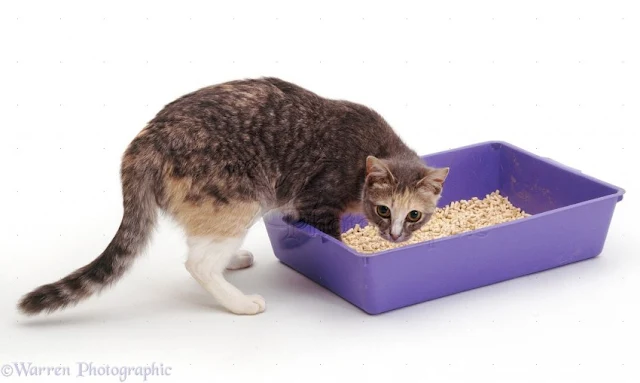
Therefore, there is a window between the moment a domestic cat defecates in the cat litter to 24 hours later when their faeces are not infective in terms of the toxoplasma gondii protozoan. That being accepted, if a cat owner cleans out the litter tray every day within 24 hours of it being used by their cat, they will not be exposed to infective toxoplasma oocysts.
This is provided they have been careful in cleaning the litter tray the day before and ensured that no faeces remain. To recap, if a cat caregiver ensures that they thoroughly clean the litter tray daily (on a strict basis) they should pretty well eliminate the possibility of being infected by this zoonotic disease through contact with a cat's faeces. I think that is quite an important statement because it deals effectively with this mode of transmission which has been discussed a lot on the Internet.
No raw treats or unpasteurised milk
And what I said above can be supported by this further information. If you only provide an indoor cat with commercially manufactured cat food there is no possibility that they can ingest the protozoan in food. However, if you feed them raw pork or beef or unpasteurised dairy products which might contain the toxoplasma organism, and they might contract the disease. So, there's two sides to this preventative process. You don't let your cat ingest the protozoan and you prevent them transmitting the protozoan through their faeces as described above. Tackled this way I don't perceive a problem with this disease for a family who looks after a full-time indoor cat.
| Clean it every 24 hours for indoor cats to avoid a toxoplasma gondii infection from cat feces. Photo: Warren Photographic. |
Children exposed to cats and mental health when adults
Today, I also read about a study which stated that, on my interpretation, children exposed to the family's domestic cat are 8 percent more likely to suffer from some sort of mental health problem when they are an adult compared to those adults who were not exposed to a domestic cat when there are children.
In round terms, what the study concluded is that due to the possibility of being infected with toxoplasmosis when they are children, they are more likely to have mental health problems because of the presence of this disease in the brain when they are adults. It's a relatively small added risk but it is, at 8%, recognisable.
Please click on this link when you have finished reading this page for a cross-post on this topic.
We don't need to believe in the study but we should at least take note of it. Clearly, the tip about the cat litter that I mention above is significant in eliminating this added risk. Particularly as it is probably not unlikely that children will be assisting the household by cleaning out the cat litter tray.
If they follow the method that I have mentioned it should all but eliminate the risk and place children with cats on a par with other children who don't come into contact with a cat in terms of mental health when they are adults.
Wednesday, 24 November 2021
Hawaiian government procrastinates about how to deal with their 'cat problem'
US News today reports on a male Hawaiian monk seal dying after a five-week battle with toxoplasmosis. It has prompted another discussion about how Hawaii should deal with both domestic and feral cats. The argument is that the toxoplasma oocysts which are shed in both feral and domestic cat faeces (once) somehow make their way to the sea where monk seals ingest the oocysts and become infected with toxoplasmosis.
![]() |
| Comparison of size of Hawaii 4 main islands with UK. Image: MikeB from mylifeelsewhere.com. |
They tried to save this seal but, as mentioned, it died. The seal, known as RW22, was treated at the Marine Mammal Center. They called on cat owners to keep their pets indoors and to dispose of faeces in cat litter in the trash. It's another instance of where putting cat litter down the toilet is a bad idea. It has to going to landfill. However, I guess oocysts can still make it to the sea from landfill under certain circumstances.
But the point of this article is that in 2016, five years ago, there was a report of eight monk seals dying for the same reason. The symptoms in the infected seals vary but they included lesions in the brain, adrenal glands, diaphragm, lymph nodes and spleen. In the case of RW22, the seal showed signs of partial facial nerve paralysis and a corneal ulcer which they believed were symptoms of toxoplasmosis.
So there is an ongoing problem if the experts are right in Hawaii of feral and domestic cat faeces making their way to the ocean around the four main islands. And little or nothing has been done about it, it seems to me, over the intervening five years and I presume longer.
They are constantly moaning about a feral cat problem on Hawaii with the cats attacking precious Hawaiian birds. There's been report about that as well. They appear to be scratching their heads about how to deal with the problem.
I think the real problem is a lack of leadership in the Hawaiian government. This is combined with a lack of commitment in dealing with this problem.
One website louisegund.com tells me that there are TNR programs on Hawaii run by volunteers which is very normal but that the government opposes them. They don't think it works. That too is quite normal. Some people support TNR and others disagree with it. It is too slow for some and returning the cats to where they came from doesn't make sense to some people.
However, the 4 Hawaiian main islands are about 1/15 the size of the UK. The point is that it is not a huge geographic area and it makes me believe that the government could successfully operate widespread TNR on the three smaller islands to start off with.
They could support the volunteers and formalise TNR programs to make them more widespread and therefore more effective. Currently it is the only way to deal with feral cats humanely. You have to deal with the cats humanely because people put them there. And killing them is ineffective due to the vacuum effect.
RELATED: Kerala, India: High Court orders registration of companion animals
In parallel with that there should be more determined approach to managing domestic cat ownership and raising standards. You'll find quite a lot of discussion in other parts of the world on obligatory micro-chipping, spaying and neutering and on occasions curfews either during the night to keep the cats inside or even mandating keeping cats within the bounds of the owner's property full-time.
I'm not saying that that is the way to go but with a manageable human population size it may be feasible to operate obligatory registration of domestic cats and from there to make micro-chipping and spaying and neutering obligatory as well. The hard part is effective enforcement of mandatory pet registration laws.
This would improve domestic cat ownership, reduce the number of unwanted cats, reduce the number of feral cats in parallel with TNR which will gradually over a period of say 20 years reduce the population of feral cats. It's a long-term project. There is no other way. But if they'd started this 20 years ago they would have made some progress by now.
Featured Post
i hate cats
i hate cats, no i hate f**k**g cats is what some people say when they dislike cats. But they nearly always don't explain why. It appe...
Popular posts
-
The big Maine Coon cat (MC) is very impressive and the biggest purely domestic cat in the world (I am excluding the wildcat hybrids ) but no...
-
Photo of Nebelung Cat Lovenblues Mozart Bronikowski copyright © Helmi Flick – please respect copyright. The Nebelung has a medi...
-
Russian Blue Kitten photograph by Sensual Shadows Photography Before you go in search of Russian Blue Kittens have a look at these and h...