‏إظهار الرسائل ذات التسميات wandering cat. إظهار كافة الرسائل

الجمعة، 30 يونيو 2023

How to minimise your cat wandering too far from the cat-flap

Wandering cat
Wandering cat. Image: SVEN HERSELMAN.

I can think of two ways to minimise the distance that your domestic cat companion travels away from your home if they are indoor/outdoor cats. These are my tips:

  1. Feed your cat well with high quality wet cat food and some dry cat food for grazing at night. It has been found and indeed suggested by a very well-known cat behaviourist, Dr. Jon Bradshaw, that when domestic cats are fed well and regularly, they have less inclination to patrol over large areas. Domestic cat will inherently patrol their territory if they are allowed outside because this is instinctive wild cat behaviour. But when well fed it dampens that desire. It shrinks their home range because one reason for having a home range is to have a territory within which they can hunt. The hunting desire is somewhat dampened when well fed although not eliminated because the desire to hunt is not directly linked to feeling hungry. This is also inherited from the wildcat ancestor.
  2. Secondly, among the wild cat species of all kinds, you will find that the female's home range is considerably smaller than the male's. In fact, for the tiger, female home ranges are often encompassed by a single male home range. It's a kind of male harem. But the point is this: adopting a female cat should mean that they travel less distance from the cat flap.
RELATED: The misogynistic world of tiger property rights!

The above two points have, clearly, distinct advantages to the cat caregiver such as:

  • Less desire to hunt native species which should please conservationists and indeed the owner.
  • Less desire to roam widely. They might roam no more than 50 yards from the cat flap or even stay within the back yard.
  • Improved relationships with neighbours potentially because there will be less desire to roam onto neighbours' backyards or back gardens.
  • Less risk of injury through wandering onto roads and being hit by vehicles.
  • Less risk of injury generally as there is less opportunity to encounter hazards.
  • Less risk of being lost.

الخميس، 15 يونيو 2023

Ginger tabby cat embarks a Japanese train and is politely ejected

This couple of photographs have received a certain amount of fame on Twitter. The story went viral I guess for two reasons. Firstly, it is unusual for a wandering domestic cat to get onto a railway station platform and then try and jump onto a train. This has to be a very confident cat without fear of strangers and strange events.

Ginger tabby cat tries to embark a Japanese train and is politely ejected
Ginger tabby cat tries to embark a Japanese train and is politely ejected by the guard or driver. Image: Twitter.

Or perhaps the cat was used to getting onto trains! The train in question runs along the Kamaishi Line in Eastern Japan.

I'm told that the cat actually got onto the train and stayed there for 30 seconds before the driver or the guard spotted him and politely ejected him. He didn't have a ticket!

My guess is that he is male because nearly all ginger tabby cats are male.

This isn't the first time that cats have been seen to jump onto public transport. I've seen several domestic cats jump onto buses in the UK. Not in person but in videos and photographs online.

Japan is quite famous for its stray cats. They do like their cats in Japan and are generally respectful of them.

On the mothership.com website there is another photograph of another cat on a train integrating nicely with the passengers one of whom is reading a book. The cat joins him in reading that book! It looks as though this cat was on the train for quite a long time. See image below:

Domestic cat travels on Japanese train
Domestic cat travels on Japanese train. Image: Mothership.com

What kind of cat does this? Both these cats look fit and in good condition. They might be fully-fledged domestic cats living with a human caregiver but with a great tendency to wander. They might disappear for a day or two and then come home. Sometimes cats are like that.

They might be stray cats who are looked after and therefore you might call them "community cats". It looks dangerous to me. I am fearful for their safety.

I've seen one domestic cat snoozing on the ticket barrier at an underground station.  It must have been warm. And another sleeping just at the top end of an escalator in an underground station. At the exact point where many thousands of people exit the escalator. Amazing and extraordinary. Once again, I expect the cat was there because the electric motor was just below the surface emitting heat.

These cats like human activity but above all warmth. They might be lonely. They might live in a home where the owner is out all day. That's a remote possibility but it does take quite an extraordinary cat to put themselves in such vulnerable positions surrounded by many thousands of people throughout the day.

الأربعاء، 14 يونيو 2023

What would you do if your mostly indoor cat goes outside and doesn't want to come home?

Sometimes you might do all you can to keep your cat safe and secure. You make them a full-time indoor cat and you look after them well. Or they might be a mainly indoor cat and sometimes they go outside and return willingly.

If your cat was raised as a stray or feral cat, they might want to revert to the outdoors lifestyle because it is a lifestyle that they know. It's those early weeks - the first seven weeks of life - which are so important for a cat. What they learn during that sensitive time they carry with them all their lives.

It is actually a bigger issue than that as all domestic cats are barely domesticated it is said. Arguably their natural instinct is to live outside the artificial environment of the human home.

Cat prefers to live outside the human home
Cat prefers to live outside the human home. Image: in public domain.

If you have domesticated a feral cat or adopted a rescue cat that was a stray or feral cat, they might want to revert to the wild so to speak.

They simply might prefer to live outside the human environment which means the human home. And in my opinion, there is not much you can do about it. You may see them, talk to them and try and entice them back but they decide to stay in the 'wild'. 

You can try and keep them inside full-time and more importantly transform the inside of your home to where it becomes very cat friendly with a catio or two and some window boxes to sit in to watch the outside (cat TV). There would be a couple of climbing trees up to the ceiling and so on and so forth.

But this would be something that a typical homeowner does not want because they want their home to accommodate humans and being entirely suitable for humans. A compromise is the way forward.

However, if a cat with an urge to live outside wants to vacate a home which has been reasonably modified to accommodate cat behaviour, they'll do it no matter. 

The rather negative point that I'm making is that on some occasions domestic cats simply want to live outside and are prepared to put up with the hardship. If that is the case, there is not much you can do about it.

You may have to kiss your cat goodbye because ultimately people don't own cats. They possess them if you want to put it that way. They probably don't even possess them. They live with domestic cats and care for them but they have their own mind and you have to let them express their own behaviours in the hope and expectation that your efforts will be sufficient to keep them with you as a companion.

There is the faint possibility that another cat - provided that cat really gets along with the resident cat - might help to keep the cat at home; to 'anchor' them. That's a chancy way to proceed because often resident cats don't get along well with incoming cats. 

And a former stray cat is likely to be more territorial than is typically encountered. That might make them more difficult when asking them to get along with a new cat.

الأحد، 7 أغسطس 2022

How do I stop my neighbour feeding my cat?

The best idea that I can think of to stop your neighbour feeding your cat is this one. You fit a dietary alert collar to your wandering cat. The collar has the following message on it: PLEASE DO NOT FEED ME and on the buckle, there is a medical warning sign. If you can buy a customised collar whereby the manufacturer allows you to choose your own words then you could put something like the following on it: I'M ALLERGIC TO CERTAIN FOODS - PLEASE DO NOT FEED ME! This is better.

Dietary alert collar

Alternatively, you can buy a collar with the above words on it and with a tag attached to the collar which certainly can be customised on which you can put a warning about your cat being allergic to certain foods but don't tell them what foods, obviously. This might frighten your neighbour to stop feeding your cat.
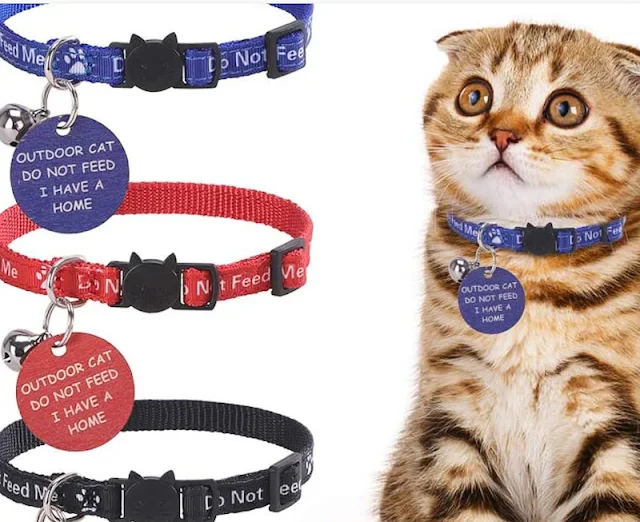
Dietary alert collar for a cat who is being fed by a neighbour and becoming obese
Dietary alert collar for a cat who is being fed by a neighbour and becoming obese. Screenshot.

I think the best way to stop your neighbour feeding your cat is through fear! That sounds a bit harsh but I don't think you will succeed by simply talking to your neighbour.

Clearly, you can put on the collar's tag the name of your cat and the phone number which would allow your neighbour to telephone you and discuss the matter and then you could ask them to stop feeding your cat but, as mentioned, I think this has a high chance of failure.

I say that because when a wondering cat constantly visits a nice home occupied by a nice person, they will enjoy the experience and come back. This is not a criticism of the home in which they live. It is just that some domestic cats don't feel attached quite so strongly to their human caregiver. All domestic cats have this slightly loose relationship in any case.

It doesn't matter how good a caregiver you are; some cats are going to wander and it doesn't matter how sensible the neighbour is. If they have a nice cat constantly visiting and they enjoy their company they might be tempted - even if told not to - to feed them.

But a stern warning which sends a message that if they feed your cat, they might harm them would, I believe, have a greater prospect of success.

This perennial problem is being faced by Fiona Keddie Ord who lives in Amersham, UK. The city has a Facebook page and her two cats, Simba and Arlo, wander off regularly. She lives in a nice part of the country and she does not want to keep them inside permanently because they enjoy the outside which is apparently pretty safe.

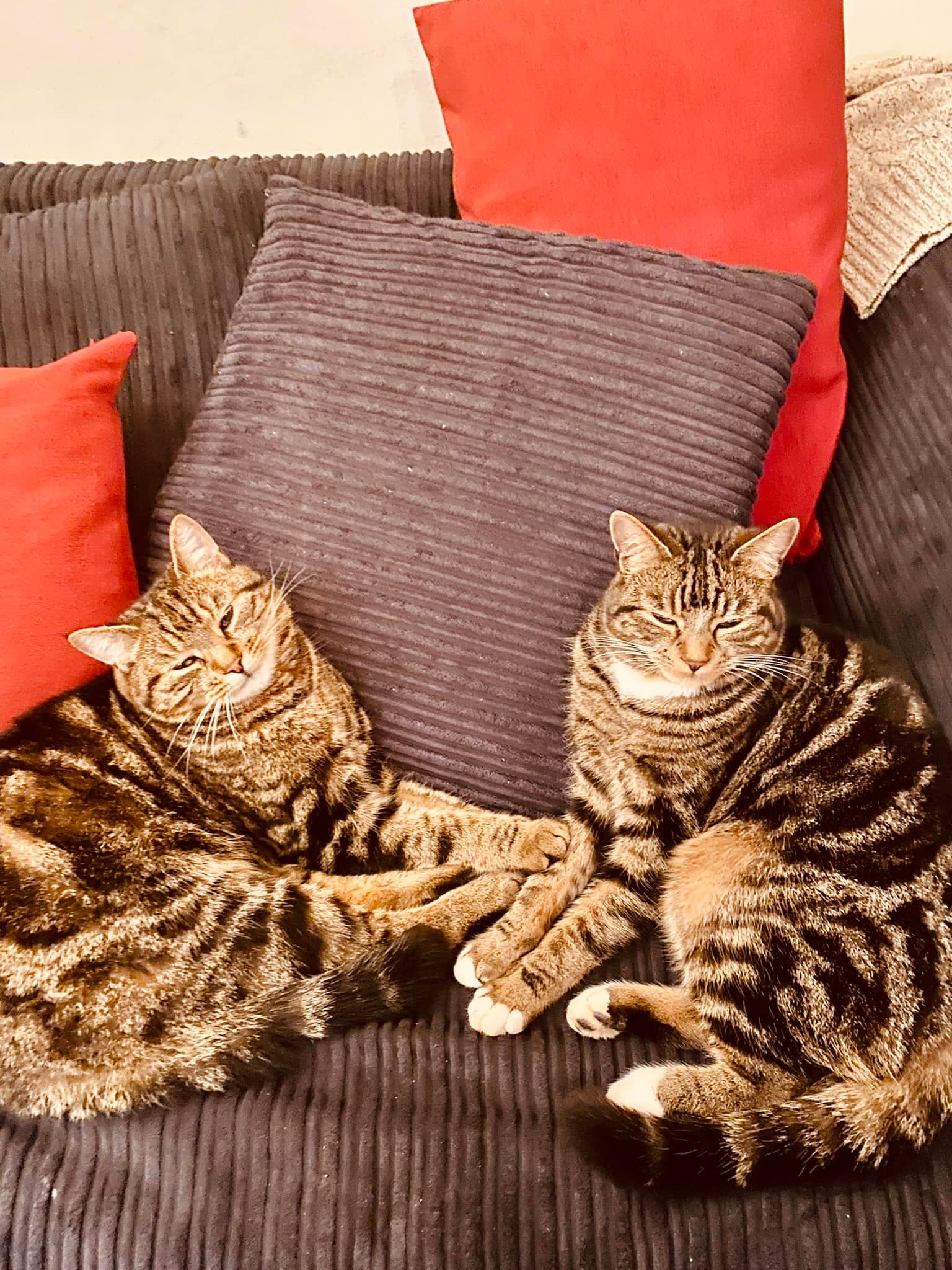
Arlo (right, white socks) & Simba (left, no socks)
Arlo (right, white socks) & Simba (left, no socks). Image: FB.

RELATED: Woman issues flyer asking neighbours to stop feeding her cat. Who’s at fault?

But her neighbour feeds them and she is concerned about them putting on weight. She posted on the Amersham Facebook page a polite request saying:

“A gentle and polite request. These are our beloved cats, Arlo (right, white socks) & Simba (left, no socks). Simba often wanders from home for days because we suspect he is being fed treats from other homes. If so, please do not.

"He is fed the correct amounts of healthy food and additional food is not good for cats. We have to take him for his yearly health check and can’t because he is irregularly home. These cats are well looked after.

"You should never feed other owners’ animals. They may need specific foods, they may become overfed. If you come across an animal that seems mistreated or not looked after, take to a local vet to track owners or report. Do not assume and feed treats. Thank you.”

I don't know whether the post succeeded but she received lots of comments from other members of this Facebook page, one of whom suggested that she keeps cats indoors full-time, which she rejected.

Another queried why neighbours sometimes feed other neighbours' cats. They know it's not a good thing to do and they know it might upset their neighbour and cause a health problem in the cat because they might become obese. This is because cats will eat even when they're not angry sometimes. But they still do it. It's human nature.

What they should be doing really is discourage their neighbour's cats coming onto their property by gently shooing them away or making it clear to the cat that they are unwelcome. A gentle person might find this hard to do particularly when they are an animal lover. Punishment should not be involved. It should be 'divine intervention'.

RELATED: Cat punishment versus divine intervention.

But it clearly is the best thing to do unless the cat is in a bad way and underfed. Under these circumstances the neighbour's reaction should be entirely different. They have a duty to care for that cat and if necessary, take them to the local veterinarian for a checkup and treatment if they can't contact the neighbour and even if the can because the neighbour will probably be irresponsible.

Featured Post

i hate cats

i hate cats, no i hate f**k**g cats is what some people say when they dislike cats. But they nearly always don't explain why. It appe...

Popular posts