![]() |
| Painting of a man leash walking his cat in the British countryside at sunset. |
![]() |
| Jade and Figaro. Picture by Jade. |
![]() |
| Painting of a man leash walking his cat in the British countryside at sunset. |
![]() |
| Jade and Figaro. Picture by Jade. |
I have just visited my doctor's surgery. I walked down to the clinic (about 25 minutes) and on the way back I saw a beautiful Bengal cat on the sidewalk and then crossing the road before entering the grounds of his home through the grille of a fence where he marked his territory against an object in the front garden. It got me thinking. Why was this Bengal cat outside wandering freely? Should you let your Bengal cat outside? And the answer is, it depends.
Here is the cat I describe. It is a poor quality picture I am afraid:
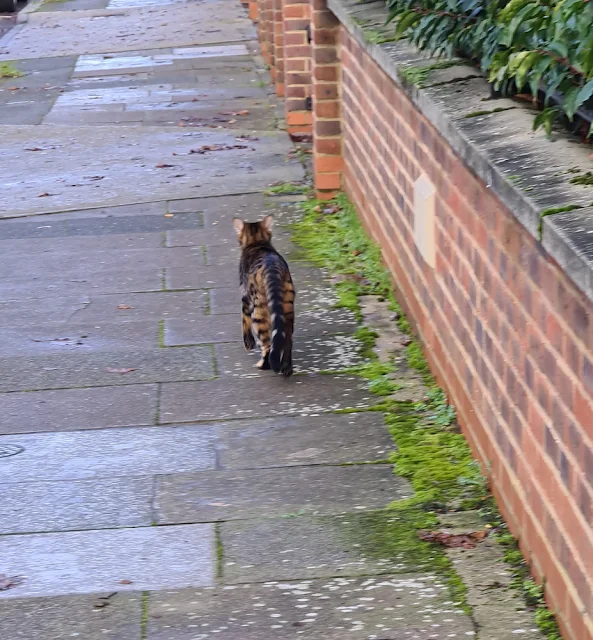
![]() |
| Bengal cat wandering outside in Kingston Upon Thames. Image: MikeB |
I do not believe that you can let your Bengal cat go outside in the way that I saw today, to roam freely at will wherever they want to. Bengals are too glamorous and too enticing to steal. The cat I saw was beautiful and stood out.
However, I do believe that Bengal cats should be allowed outside under supervision. This means that if, in the instance I refer to above, you live in a city, it must mean on a lead and harness. You can teach your Bengal cat to accept a lead and harness. This is much easier if you do it when they are young and ideally a kitten.
Most domestic cats need training to accept a harness and lead. Once you do they will generally walk with you although not like a dog. You are going to need a lot of patience and going nowhere for a while they investigate their immediate surroundings. Taking a smart phone with you to surf the internet will help with your patience 😃✔️. But keep a look out for dangers such as dogs.
Also, you can allow a Bengal cat outside if you have a backyard without trees and around which you can place a cat confinement fence. This may be very effective. I think, however, that it will be less effective than a harness and lead.
The reason is that a Bengal cat might be able to escape a cat confinement fence even if it is customised and cleverly constructed. Bengal cats are very athletic, inquisitive and determined. Of all the domestic cats the Bengal is the most likely to escape a cat confinement fence around a backyard.
A third option is a catio which allows a Bengal cat to smell the air and perhaps feel some grass under their feet. Catios are a good compromise between keeping a domestic cat indoors full-time and allowing them to have some sense of nature and stimulation from nature.
The need to stimulate a domestic cat is particularly important with Bengals because they are wildcat hybrids. Wildcat hybrids are generally slightly more intelligent than your typical domestic cat because they inherit their intelligence from their wild cat counterpart which for the Bengal cat is the Asiatic leopard cat.
And because they are confined to the indoors full-time they are likely to get bored and they might become a bit difficult. Plenty of stimulation which means playing with them and customising the interior of your home with, for example, a catio, and climbers is the way forward.
Personally, I would go for adopting a Bengal kitten and immediately train them to accept a harness and lead from the get go and take them out. The harness should be a thick and secure one. You do not want your Bengal cat wriggling free. Some of the earlier harnesses and the cheaper ones are not, in my opinion, secure enough to stop an anxious Bengal cat wriggling out and running away.
Sometimes domestic cats become anxious and excitable when in a harness on a lead. This can make them do stupid things and in the wrong environment those stupid actions can lead to harm.
Good training when young and sensible supervision when on a lead is the answer.
Dr. Bruce Fogle, the UK's number one veterinarian/author, boldly and confidently states that training your cat is logical. Domestic cats train themselves very often and they sometimes train their owner as well. It is a mutual form of training.
In one of his books, Complete Cat Care he says that when cat owners come into his veterinary clinic it is pretty normal for them to feel guilty about not letting their cats go outdoors. And he recommends what I recommend by saying that:
"If you want to give your cat the option of going outdoors, and it too dangerous for it to do so on its own, training it to walk on a lead is an option for any relaxed cat that's not fearful of the outdoors."
Bengal cats are normally pretty confident and therefore should not be fearful of the outdoors. You can go online, I would suggest Amazon, to find a thoroughly sound harness and lead. Some harnesses are much easier to get into than others. I would pick one of those because it can be difficult to get a cat into a harness! But there again if they are trained from kittenhood it shouldn't be a problem.
Bruce has some lead-training tips and here they are:
The councillors of the city of Fremantle in Western Australia want to ban freeroaming domestic cats. They will have to be on a leash if they have their way. Soon cats could be prohibited from all city-owned and managed properties. This is one more step in the pressure being applied by legislators in Australia to domestic cat ownership in order to constrain free movement and protect native wildlife.
![]() |
| Photo: Pixabay. This is the kind of cat you'd keep on a leash without laws to make you do it as she is beatiful. |
There is a gradual, insidious almost, expansion of the concept of limiting the freedoms of domestic cats and restricting domestic cat caretaking. I am not against it as long as cat welfare is also dealt with. Constraining cats can lead to bored cats and a lack of stimulation. This can lead to health problems.
In this instance, the motion for the change in the local law was put forward by Councillor Adin Lang. It was backed at a meeting this week according to The Daily Mail. Domestic cats will also have to be on a leash when in other areas such as bushland areas, verge gardens and other areas considered to be wildlife refuges.
The proposal is also to prohibit cats from going onto roads. I find that very peculiar but it is the report. They intend to amend an existing law, the Cat Management Local Law 2020.
Adin Lang wants, it seems to me, the same rules applying to cats that are in operation for dogs. Dogs can't roam around freely and he wants the same thing for cats. Back in 1970s dogs were allowed to roam freely but it's been very different for a very long time.
RELATED: Walking your cat on a leash to explore and stimulate. A lifestyle to aspire to?
The proposed law will also help protect cats and keep them safer. I'm told that there are 750 cats registered in Fremantle. That implies that there is an obligation on cat owners to register cats in that city. How successful is that? This is a low number. My research immediately confirmed that domestic cat registration plus microchipping and sterilisation is obligatory in Fremantle. Breach of the ordinance results in $5,000 fine per item.
The proposed amendment to the law will be drafted and then be put to the council. They might seek feedback from the community before they try and turn it into a law. It could still be disallowed by the State Parliament's Joint Standing Committee on Delegated Legislation.
RELATED: Why don’t cats walk on leashes?
Postscript: if you've tried to leash train your cat you will know that it is not easy. The character of domestic cats does not lend itself to walking contentedly by your side on a lead. It is possible to train cats to do it but I don't think I've ever seen a story about a domestic cat being leash trained to walk down the sidewalk or pavement for any considerable distance in suburbia. You see leash trained cats trekking with their hiking owners. But that's rare too. And this is in the middle of nowhere so it is quiet.
I suspect that if there is a law which states that you must take your cat out on a lead nobody will do it. They will simply keep their cats inside instead. This is a potential health problem.
There is a funny side to trying to get your cat to walk on a leash and there's a disastrous side to it because it can be so damn stressful for the owner; as one of the ladies in the video makes clear. Perhaps an important aspect of this video is that it shows cats being put in a harness and taken for a walk for the first time. Things change.
![]() |
| Bushwah an F1 male Chausie on a leash. Photo: Helmi Flick. |
These are typical reactions. One guy in the video does take his cat for a walk. He's a 'cat-man'. He is completely correct in saying that if you want to get a cat to do something you have to trick them into believing that they want to do it. You can't force a cat to do something.
![]() |
| It takes 2 women to get this harness on their cat. Screenshot. |
But he is very patient and he has got his cat to walk on a lead through that patience. And that is the point, domestic cats will get used to a lead if you are patient enough. The initial reaction is rejection both in attaching the lead to them and then trying to walk on the lead.
The whole thing can be fraught with difficulties and indeed dangers. In the video you see the black and white cat trying to get out of the harness. They are obviously outside the home. If the cat succeeds, he or she may run away in terror. That can present some really big issues for a cat owner. This is a put off to trying to take your cat for a walk on a lead.
Note: This is a video from another website. Sometimes they are deleted at source which stops them working on this site. If that has happened, I apologise but I have no control over it.
What if a dog arrives and your cat panics and breaks free of the lead and disappears? These are the reasons why people don't take their cats for a walk on a lead even though it is really an excellent idea especially for full-time indoor cats. It gets them out safely; great stimulation but great stress for the caregiver.
Perhaps the biggest barrier with trying to get your cat to walk on a leash is that they tend to flop to the ground as if paralysed. This is one of the great mysteries of the feline world. Whereas dogs love to be taken out on a lead, cats tend to rollover, belly-up and have to be dragged along.
![]() |
| Thundershirt. Pic in public domain. |
I don't think that I have seen a satisfactory reason for this feline response. I have proposed that it is very similar to the response that cats have to the cat product called the 'Thundershirt' (see above) which you can buy online. It is a harness-like product which envelopes the cat or dog and calms them. It does so by the pressure on their bodies. It is effective but I don't recall anybody explaining why! Clearly pressure on the body calms a cat and dog. In the case of a cat, it calms them so much they become almost comatose and paralysed.
Although individual cats respond in different ways. Some will accept the harness much more readily than others. This paralysis response is the initial response. They get used to it and they stop falling over and they start walking. And then gradually, little by little, you will end up taking your cat for a walk on a leash. You just have to go through these barriers.
There is an alternative to the leash, which is the cat stroller. This is also an unusual product. I have both a harness and they cat stroller in my home. I like them both. Anything that helps to make a cat's life more enjoyable through new experiences and stimulation should be the objective of all cat caregivers.
![]() |
| Culkin walking his cat in a stroller. Photo: Reddit. |
The only problem with the cat stroller is getting the cat into it! It's a bit like getting them into a cat carrier when taken them to a vet. Although this will vary tremendously because cats should learn to enjoy being in the cat stroller and when that happens, they will not object to being put inside. At least, that's the theory.
CLICK FOR SOME PAGES ON 'LEASH LAWS'
Incidentally, cat strollers are great ways to meet people because passers-by invariably want to talk about it. They initially see a baby in a pram and then in the Eureka moment that follows they see the cat which prompts spontaneous conversation.
This is about providing your cat with an enriched environment. Something as simple as walking your cat around the front or backyard of your home once a day for, say, 20 minutes will be something that your cat can look forward to if she/he is a full-time indoor cat.
It really doesn't have to be something exotic and clever. It's just allowing your cat to 'connect' with nature as best you can achieve it. This will be in stark contrast to being inside the home which is entirely artificial and the human world.
![]() |
| For a full-time indoor cat, a walk on the leash in the garden will be thoroughly enjoyed. Photo: Getty Images (harpazo_hope) |
There is a good example of this on the Internet right now from The Guardian newspaper. Interestingly, it concerns a family living in the suburbs of Melbourne, Australia. We know how sensitive the Australian government and indeed Australian citizens are to the predation of native species by domestic cats. This man, James Shackell, decided he wanted to enrich his cat's life, so the benefits of wildlife conservation was a secondary matter.
As expected, it took a while for his cat, Monkey, to adjust to wearing a harness because they almost invariably cause a cat to flop over on their side and become totally passive and immobilised. It is as if they have been zapped with a taser. But bit-by-bit they get used to it and are able to walk fairly normally when wearing one.
And so with patience James took Monkey out to his front garden and over time Monkey learned to love it and he would encourage James to take him out. It has become a daily ritual and whenever he grabs the lead Monkey trills and purrs and runs to the front door "like an excited puppy". Great to see. You know you are doing well as a cat guardian when you see that feline behavior.
I would expect his front garden not to be an enormous 'domain' of several acres but quite small but it is large enough for a domestic cat to enjoy smelling the earth, the grass and the scents that waft in on the breeze. And to feel the earth and grass under his paws is a great experience for an indoor cat.
The point of this brief note is to say that something as simple and is easy to do as this will have great benefits to a full-time indoor cat and therefore it should be done if at all possible. I am passionate about trying to encourage people to ensure that their cat enjoys nature. It will be a compromise, as demonstrated by the arrangements of James, but this is far better than nothing at all.
One downside which he has got used to is that his neighbours think that he is eccentric. It's funny but people do see cats on leashes and cats in strollers as very strange. This is because it is still very rare and a lot of people have preconceived views about domestic gas being independent and free roaming.
Both the cat stroller and the cat leash are excellent tools to work out a compromise to allowing a cat to behave naturally while protecting them from injury and protecting nature from the predatory instinct of this beloved animal companion.
P.S. An alternative is to build a large backyard enclosure but that is far more expensive and intrusive. It is still a good idea though if you are up to the disruption. It will hard though to convert a free-roaming cat to a confined cat. Be prepared for difficulties and/or failure.
![]() |
| Arya asks to go for a walk outside on a leash. |
@aryathelittlecat It’s 11pm I gotta sleep ##fyp ##catsoftiktok
♬ original sound - aryathelittlecat
i hate cats, no i hate f**k**g cats is what some people say when they dislike cats. But they nearly always don't explain why. It appe...